Showing posts with label Video. Show all posts

June 29, 2015

2015: Patrick Bobilin on Leaving Chicago

Paul Germanos: Hold old are you? Where are you from? When did you come here? Is Chicago one of many stops on your journey?

Patrick Bobilin: I’ve decided that I’m too old to be in Chicago.

I didn’t begin with any sort of map, unlike many of the people who I’ve encountered in Chicago and abroad. Lots of people in the arts start off with some kind of drive, or some kind of medium that grounds them. Some people start off with a family member, or a loved one, or a teacher who inspires them. Others--most people living in the world--see art as a permanent hobby; even now, the term “hobby” runs a sad chill down my spine and across my hardened heart.

I grew up in New York, lived both in the city and in the country, and was on a path which led towards a respectable, but unremarkable, adulthood--till a meeting with Peter Edwards (now a friend for life) who took my interest in music and added the twist of instrument/guitar pedal/circuit building. I started then to understand that I could take whatever means were at hand and use them to express whatever I was feeling, and do so with an exactitude which I couldn’t when I felt limited by access, education and money. It’s always been about money and perhaps it always will be.

At this point, Chicago has become just one of many stops, because I’ve tapped into a way to earn a little bit of money, given my patience for learning and writing [computer programming] code. Now, New York is accessible. However, my interest in becoming part of the art elite has since waned: I went into great debt for three separate degrees in the arts, guided by the idea that the field was a meritocracy; at this point I’m both sad and confused that either: (a) many people still believe it is, or (b) it’s some sort of open secret that each art person is left to individually discover, to their own disappointment. Chicago will never be anything but a stop on anyone’s journey because we’re not all moving targets. Publications like e-flux seem to celebrate this. Good for them; sad for everyone else not in on the joke.

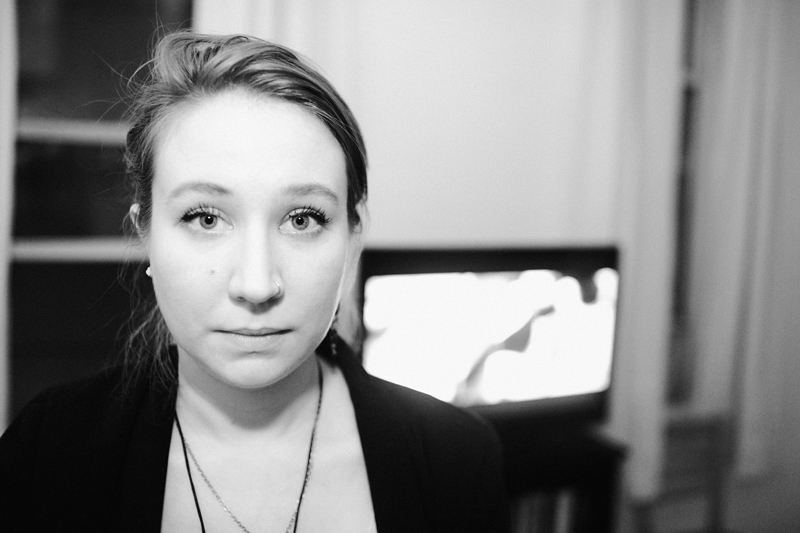
Above: Patrick Bobilin; black and white (halftone) filter applied; resized for publication.
PG: For what did you hope when you came to Chicago? A degree? A job? What did you think that you'd find here? What was your first impression of the city?

PB: I came to Chicago after living in Berlin. I was failing at making it as an artist: competing for grants I had no hope of getting. And so I decided to get BETTER at art (lol) and applied for a few Masters programs. I got into everything I applied for except the one I really wanted: the Masters of Science in Visual Arts at the Massachusetts Institute of Technology. I kind of just wanted to throw it in the face of the kids I don’t plan on having when they questioned my authority: “HOW DARE YOU?! DON’T YOU KNOW I’M A MASTER OF SCIENCES?!”

There’s this vague suggestion in art school--which no one seemed to really pull apart--that if you didn’t become a famous gallery artist, you could always teach. And that seemed like the only possible and meaningful job after a graduate degree. The problem, to me, was always the attitude: artists COULD teach if they got in a jam, or needed the extra money, or had an in to help scratch their rent together. Chicago is full of people who are working as teachers as a result of their failure to achieve art stardom.

I love teaching. I’m happy for the opportunities I had, first as a teaching assistant and later as an instructor, at the School of the Art Institute of Chicago, and also with the non-profit CAPE. I know that I have limits when it comes to dealing with under-served youth, people who are always "Going Through Some Shit," but I made long-term connections with some of my students, and I’m grateful for that. However, I know they’re not long for Chicago. They’ll be leaving for better jobs, or at least better opportunities, like most everyone does. The boat isn’t that big. And with SAIC constantly expanding and widening its specialties and types of degrees, it has become the destroyer. One of many, but a destroyer nonetheless. Like nature, economies and creative ecosystems are about balance.

Chicago is a wonderful training ground for creatives. And now that I’m more involved in the comedy world, I can knowledgeably use that as an example: Half of all the people who've been on SNL have come through Chicago; and anyone who’s stayed in Chicago isn’t doing comedy anymore. The coasts vacuum out Chicago's talent; and it’s certainly not by the hand of god. New York and Los Angeles do the weeding. Chicago itself doesn’t seem to do any vetting; it’s a blessing and it's a curse. Chicago’s a city full of hard-working people who are sharpening their teeth and/or burning out. And it's better to leave while you still have the energy to do good work.


PG: Did you attend a school here? Which school did you attend? How long were you in school here? Did you receive a degree here? When did you receive your degree?

PB: I went to SAIC for two years, while running a gallery [Noble & Superior Projects] which I would call successful by attendance and notoriety alone. I got my MFA in film/video because it’s really fucking easy (no one fails) and then immediately went to Bard for an MA in Curatorial Studies. I was done with all of it by New Years Day 2012. Hard to believe it was only three and a half years; but that’s the story. Had some shitty jobs before and after; but they all run together. Paying to work for SAIC (via student loans aka financial aid aka is this the best you can do, America?) was the second best job I’ve ever had. Hampshire College was more fun, though I didn’t appreciate it at the time.

Above: Noble & Superior Projects logo.
PG: How long were you in practice here? Did you enjoy success on your own terms? Can you recall some peak experience? If you felt frustrated, what frustrated you? Poor sales? Lack of publicity? High rent? Crime? Inefficient transportation? Public apathy? Bad weather? What was the total amount of time that you spent as a resident?

PB: I was in practice here from the moment I landed in 2009. I had no money, and so I subsisted on the goodwill (read: wine and snacks) of the many galleries in this city. A quick Google search led me to Stephanie Burke’s gallery listings, and I fell in love with the Chicago art world.

I had moved from Berlin where I was introduced to the idea of the apartment gallery (after only experiencing one other such thing: Gallery TK, in Northampton, Massachusetts--shout out to Lauren van Haaften-Schick) and I knew I had to have one.

I had things that I loved, and I hoped that I could put them together to deal with the things that I hated. The problem I saw was that all the apartment gallerists, and the artists in these apartment galleries, tried to maintain the posture of the "Real Galleries" that I had been to, and worked for. They tried to play farm team feeding into the "Real Galleries," with price sheets that said “NFS” or “Prices on request” because they were deluded enough to think that there was someone amongst their ranks who, beneath their ironic tattoos and cut off jean shorts, had enough money to support them. They were low-key capitalists, slumming it for as long as they had to, but ready to join the ranks of those shilling art to rich people for as much cash as they could get.

So the aim of my gallery--Noble & Superior Projects--was to take some of those lessons I learned from a decade working retail (e.g., greeting people, offering incentives, making everyone feel welcome) and put them into action in the gallery context. We didn’t sell anything and we didn’t want to. Every artist had to offer some kind of free and unlimited edition to guests. We had good beer and snacks. We said "Hi," to everyone who walked through the door--especially if we didn’t recognize them. We had some really giving interns, like Elliot Reed, who I still count as amongst one of the kindest people I’ve ever met. We also put a lot of work into branding and promotion. We had lots of people who weren't "Art World Insiders" coming to a private place because we tried to make it as public as possible.

I never felt part of a clique, as a kid or as an adult, and I don’t think that most people do. I never had money; but I loved art. I needed N&SP to be for those people. The takeaways were important: if not for the artists or the art people, they were everything to me. I still have all the leftovers. They’re like the family jewels. And we paid for everything out of pocket sure, but who cares. I was on food stamps, much like the homie Corinna Kirsch, and I usually spent it all on shit for the openings. I wanted people to feel welcome, and good food breaks all barriers. We’re not saints, and you should expect to pay for things out of pocket. Otherwise, take some fucking business classes. Most art people have no idea how economics work, and how most businesses work in a deficit for years, yet they want all the benefits.

The list of things that could have frustrated me have to do with public infrastructure. And if there’s one thing I learned about artists and, worse, freelance curators, it's that they don’t vote. They don’t typically pay attention to who their alderman is, what kinds of businesses pop-up in their neighborhoods, or who really lives in their neighborhood, because it’s hard. And sometimes it means that they (the gallerists/artists/curators) probably shouldn’t be there unless they dive into their communities head-first. The idea that “crime” could be a reason for leaving Chicago is absurd if you look at the people who populate Chicago’s contemporary art world. They typically open up shop as gentrifiers; and so if they’re the victims of any crime, they may well deserve it: flaunting their privilege even when they think it doesn’t exist. After 6 years in a great little mixed-income, mixed-ethnicity pocket of the city, I’m leaving because I don’t want to gentrify another neighborhood in an effort of “Creating A Community,” and I don’t want to work in service of the ruling classes via curating. I don’t plan on doing that anywhere else; but at least in NY and LA, the lines are clear. There are fewer snakes in the grass.

PG: How does Chicago know you? Does Chicago know you? Have you been misunderstood?

PB: Chicago knows me as either the benevolent dictator of Noble & Superior Projects (2009-2011) or as an art world terrorist via social media and my web series "What Am I Looking At?" with Ali Clayton. When I talk to the people who are soon to become the architects, because they have the will for power and patience for the work, my ideas are laughed off as barely legitimate. But I steal all of my ideas from economic theory and urban planning. So it might just be that these guys are too deep in the mire to realize where they’re headed. As neighborhood after neighborhood becomes gentrified, how many artists have to leave or move to the suburbs before they realize that their model of seeking cheaper rents and creating the same kinds of projects/institutions is a well-trained arm of the neoliberal free market? Lots of ugly buzzwords, sure, but shit is real out here: real people’s rents can go up because you want to take out a loan or borrow money from your parents to start a gallery whose only--failed--aim is to sell more paintings, "Because It’s Important."


PG: Was there an event which precipitated your departure? For which other city did you leave? What was waiting for you in that other city?

PB: There were lots of things that made me want to leave: other people leaving, seeing the same people over and over, seeing new people repeat the same awkward stand-offish attitude in new spaces, etc.; but most of all, it’s the disappearance of the apartment galleries: half of them disappeared, and the other half tried to "Become Legitimate," which meant getting grants, selling art, opening storefronts and just being another art gallery that’ll never be as important as anything in Chelsea. There was a shot and they/we missed it. We could have been something else.

So, now I’m going to New York for comedy and film-making, because art must be for the wealthy, and I don’t trust those people. And I see no evidence to convince me otherwise.


PG: Does Chicago look different to you since your arrival to it and/or departure from it? Do you have advice for someone about to begin what you've finished?

PB: I really believed in social practice when I arrived in Chicago. Wholeheartedly. Passionately. Deeply. But after becoming more politically involved, as I was when I was younger, I started going to protests. It really crested for me after the Eric Garner verdict came out: I was sitting at my desk absolutely fucking devastated. I couldn’t focus. I left work early and spent an hour on Facebook and Twitter looking for protests. I called my art friends and they all had excuses. I had shit to do too; but my stomach was in knots. I went and there were a couple of thousand kids and older people. I saw no artists there. I marched for three hours, my faith in humanity restored. They had a second protest a couple of days later. I went to that too. I had signs and took photos and got pushed around by cops. I ran my voice hoarse. And I saw no one from the Chicago art world, and I fucking remember people. Shame on you, them, us. We have failed. If our purpose is to make a vacuum to make vacuous art in, then we’ve succeeded. It's something Adrian Piper said, about how implicit politics serve the neoliberal agenda. My head hasn’t been the same. The art world taught me to soften my voice. But, why? because I might scare away the money? There are real people suffering, and there are artists who have a voice and they’re afraid to speak up. It’s too much for me. There’s nothing here to lose and that’s what’s beautiful about it: Chicago is the place to try to be and do everything and fail and still be able to survive and yet it feels stuck in the past at moments like this.

PG: Do you expect to maintain a connection to Chicago and its art world? What's your incentive to stay connected? Have you left friends or family here?

PB: As my teeth have gotten sharper, my art world allies have dwindled. I know that I have that ability to polarize a room for or against me, to make quiet and polite people unrecognizable to themselves. That’s my blessing and my curse. And it’s okay. I wish I was more likable but I also need to sleep without the guilt that comes with setting your past on fire with your ethics as kindling. Once a month I make something, say something or do something that results in an email from an acquaintance or colleague. It usually reads something like: “Hey, I think that thing you did/video you made/thing you said made a lot of sense to me, and I’m glad other people think that and have the courage to say that.” I take that to heart, and it gives me a little bit of gas to get to the next thing. But it’s also sad how many people stay quiet for the sake of losing friends or opportunities. But, guess what, your real friends won’t turn their back when they disagree with you, and you don’t want to be working for someone who thinks your ideas are shitty. Happiness is honesty. Even when it’s really hard.

PG: By what means do you stay abreast of developments in the arts in Chicago? Print? Social media? Visits?

PB: I keep up with what’s going on through Facebook and Twitter, and, when I can handle it, the "deleuze-bot" (shout out to Corinna again) art writing in Newcity and places like that. But Jason Lazarus recently had that photo of “All the artists in Chicago,” or whatever, and I didn’t hear about that; so at this point I might be out of the loop. And goddamn there were a lot of white people there; am I right? What bothers me is that that’s what Chicago looks like to a lot of people. This city is 33% black and 20% Latino.[1] You wouldn’t know it from a stroll through these openings though, would you? I’d come back, but I’d only take recommendations from Stephanie Burke.

PG: In the end, is place important? Is physical location a matter of consequence in 2015?

PB: Physical location is sadly important still. People tend to stay in their circle. Artists don’t look to the suburbs, to people not affiliated with whatever institution they’re affiliated with. There’s a chasm between SAIC and Columbia College Chicago, not to mention the University of Illinois at Chicago. And some ill shit goes on there. And the University of Chicago might as well be on another planet. Circles get too comfortable, and then they become claustrophobic; and that might be what causes some of the flight.

There’s nothing to do in Chicago but take risks. Meanwhile, all I see, read and hear, are low-rent versions of what’s going on in NY and LA. The art world is becoming collapsed. A friend who I met here left doing some really weird shit. He sent me photos of his new shit and it’s "So Fucking LA." It’s of a scene; not of him. People need to take some risks. Go to a comedy show, or better yet, an open mic. Watch people fall on their faces while drunks yell horrible shit at them--especially the women. And watch them bounce back. It’s so much more hostile than the art world. It’s much closer to reality. Which is why rich people love the art world and love being around artists struggling: for that taste of reality. It’s restorative. But in comedy, when one is having to defend not necessarily their work or their ideas but their very reason for existence in that moment of heckling, you realize how futile it is to have an authentic moment in a freshly painted white cube. You can’t predict audiences; and you can’t curate sincerity. It happens: and it’s ugly and it’s amazing.


PG: Was some important subject omitted from this query? Please introduce any additional material which you believe to be relevant.

PB: Ask me about my failures, not about how I choose to represent my successes. I end up coming off very Kanye-ish otherwise.

And I think you should be asking how academics frame the art world; plenty of fields function swimmingly outside of an academic context. This gets taken for granted in Chicago. No one, ultimately, cares about where you went to school--not if you’re doing good shit.

And ask about curating too, because this thing has become an out of control monster: with curator’s names coming before the list of artists. Do you see the producer’s name before Beyonce’s name? not in a million years.

But after two hours passed while writing this on my flight to London, I just noticed that my brow has been furrowed the whole time. Use Google to search for "Candy Lawrence," and watch everything that comes up. Search for "Ali Clayton" too. All is full of love, or some shit. I’m gonna listen to D’angelo and try to sleep for a few hours.


Xoxo
<3

- June 28, 2015 (C) Patrick Bobilin

Learn more about Patrick Bobilin's professional work (with Valentina Vella) at his site: http://gradientgrid.com/

Read Jeriah Hildwine's October 3, 2011 interview with Patrick Bobilin: http://chicagoartmagazine.com/2011/10/an-introduction-to-curating-a-conversation-with-patrick-bobilin/

Find the archives for Noble & Superior Projects: http://nobleandsuperior.blogspot.com/

Additional archives for Noble & Superior Projects: https://noblesuperior.wordpress.com/

See twenty "What Am I Looking At?" a/k/a WAILA videos, dated February 1, 2013 - March 6, 2015, in the following YouTube playlist: https://www.youtube.com/playlist?list=PL7TzOBRvOf5xYvFK2YQPADpQrfm2p6UBE

Portrait above provided by Patrick Bobilin; black and white (halftone) filter applied; resized for publication.

Edited by Paul Germanos. Apologies for errors and omissions. Contact using the information at right.

[1] The United States Census for the year 2000 suggests that Chicago is nearer to 32% Black and 29% Hispanic/Latino, with 32% of its population identifying as White and 5% as Asian. See table in "Households" section at the following link: https://en.wikipedia.org/wiki/Demographics_of_Chicago

March 10, 2015

2015: Kate McQuillen @ Comfort Station

Kate McQuillen @ Comfort Station
Above: An anonymous late-night cyclist about to pass the canted bay window at the center of Kate McQuillen's "Old Flame" installation at Comfort Station, 2579 N. Milwaukee Avenue, in Logan Square, Chicago, IL, on February 21, 2015.
Kate McQuillen
"Old Flame"
Curated by Jessie Devereaux
January 24– February 22, 2015
Comfort Station
2579 N. Milwaukee Avenue, Logan Square
Chicago, IL

http://www.katemcquillen.com/

http://www.comfortstationlogansquare.org/

Saturday night, January 24, 2015: In Chicago, immediately northeast of Logan Square's Illinois Centennial Monument, the doors at 2579 N. Milwaukee Avenue are locked. And Comfort Station (a shelter for trolley riders in the 20th century, a venue for arts patrons in the 21st century) is opaque as well as inaccessible. The single story structure's street level windows are filled with gouache-tinted paper, masked and backlit to create the illusion of yellow-orange flames within.

Kate McQuillen @ Comfort Station
Above: An interior view of Comfort Station's canted bay window filled with paper and backlit for Kate McQuillen's "Old Flame" installation at 2579 N. Milwaukee Avenue, in Logan Square, Chicago, IL, as available for view on February 21, 2015. The white table supporting McQuillen's single-channel video is visible at far right, its monitor half-hidden by the surrounding yellowish material.
Puzzled would-be-attendees of the evening's opening reception periodically circumnavigate the building: looking, vainly, for a way to get in. Taken together with a single-channel video (the small screen of which peeks out towards Milwaukee Avenue) the architectural intervention is the work of thirty-five-year-old Massachusetts native Kate McQuillen, a visual artist selected for the occasion by Comfort Station curatorial panel member Jessie Devereaux. On an adjacent sidewalk a sandwich board bears a message in chalk: McQuillen and Devereaux are available at a nearby location, waiting with refreshments.

Kate McQuillen @ Comfort Station
Above: An exterior view of the single-channel video component of Kate McQuillen's "Old Flame" installation as seen through the canted bay window at Comfort Station, 2579 N. Milwaukee Avenue, in Logan Square, Chicago, IL, on January 24, 2015.
Theatrically, the staging of "Old Flame" is successful enough to engage an interested passerby. It works. Conceptually, the site-specific artwork wants for a paragraph of text which offers a historical ground for the experience. In this place, at this time, what does "Old Flame" mean?

Of course, it isn't fair to reserve that criticism for McQuillen and Devereaux. Chicago's art world, attractive largely for: (a) its schools; and, (b) its non-commercial residency, publication and exhibition system, is filled with young and short-term residents. Consequently, memory is wanting. And we have only few miserable, old, critics to suggest in writing such visual precedents as might exist.

Kate McQuillen @ Comfort Station
Above: The maquette of Comfort Station's canted bay window (photographed while available for view on February 21, 2015) which was featured in the single-channel video component of Kate McQuillen's "Old Flame" installation at 2579 N. Milwaukee Avenue, in Logan Square, Chicago, IL, January 24– February 22, 2015.
For example, Oak Park resident Alison Ruttan presented (below) a little city of burned-out modelli at Chicago's ADDS DONNA gallery in 2012.[1] And Ruttan's ceramic, architectural structures were each identical in scale to (above) the maquette of Comfort Station's canted bay window featured in McQuillen's single-channel video. In fact, Ruttan has a concurrent show (January 24 - April 26, 2015) featuring said pieces, "if all you have is a hammer, everything looks like a nail," at the Chicago Cultural Center.[2]

Alison Ruttan @ ADDS DONNA
Above: A detail of Alison Ruttan's "Natural Disaster" which ran April 15 - May 13, 2012, at ADDS DONNA, 4223 W. Lake Street, #422, Chicago, IL.
Alison Ruttan @ ADDS DONNA
Above:An overview of Alison Ruttan's "Natural Disaster," which ran April 15 - May 13, 2012, at ADDS DONNA, 4223 W. Lake Street, #422, Chicago, IL.
Alison Ruttan isn't the only artist worth mentioning. Also running concurrently (January 9 - March 15, 2015) is a group show at the University of Chicago's Logan Center entitled "Lands End," which includes works from now Brooklyn-based Carrie Schneider's 2010-2011 "Burning House" series.[3] Schneider, like McQuillen, produced an architectural prop which was literally set ablaze and photographed, the results of which (below) were first displayed at Chicago's moniquemeloche gallery in 2012.[4]

Carrie Schneider @ Monique Meloche
Above: Carrie Schneider's "Burning House (October, afternoon)" 2010, originally a c-print, 40 x 50 inches. (C) Carrie Schneider.
Carrie Schneider @ Monique Meloche
Above: An installation view of Carrie Schneider's "Burning House," which ran March 31 – May 12, 2012, at moniquemeloche gallery, 2154 W. Division Street, Chicago, IL.
If Alison Ruttan and Carrie Schneider are comparable to Kate McQuillen because of their common choice of subject matter (a building which is being or has been burned) the University of Chicago's Jason Salavon seems good to remember because of his working method: In 2009, Salavon employed computer-controlled projectors inside the Hyde Park Art Center to cause (below) animated, geometric patterns of colored light to appear across the screened clerestory--an effect enjoyable from outside the building.[5]

Jason Salavon @ Hyde Park Art Center
Above: A still, interior view of Jason Salavon's animated "Spigot (Oracle's Reflection)," which ran September 23, 2009 - February 6, 2010, across the Jackman Goldwasser Catwalk Gallery at the Hyde Park Art Center, 5020 S. Cornell Avenue, Chicago, IL.
Jason Salavon @ Hyde Park Art Center
Above: A still, exterior view of Jason Salavon's animated "Spigot (Oracle's Reflection)," which ran September 23, 2009 - February 6, 2010, across the Jackman Goldwasser Catwalk Gallery at the Hyde Park Art Center, 5020 S. Cornell Avenue, Chicago, IL. (C) Jason Salavon.
Every work cited above can be seen to hinge upon an energetic treatment of architecture. And, each artist having concerned herself with a particularly human intervention in the environment, the figure is conspicuous in its absence. Taken together, McQuillen, Ruttan, and Schneider are suggestive of a potentially alarming turn from the controlled, domestic interior of the still life towards some ambiguous violence in the landscape.

What does it mean? In Chicago, in 2015, architecture as ground for some phenomenon of light is found recurrent in practices as diverse as those maintained by Luftwerk and Colleen Plumb. In Chicago, in 2014, the strongest displays at the city's EXPO art fair took the form of architecture. Again, among other examples, Judy Ledgerwood's direct architectural paintings were paired with Anne Wilson's "Portable City" pieces at Rhona Hoffman's gallery in 2011. Whatever else might be happening, in this place, at this time, there's evidence of a widespread and persistent interest in the built dimension of the world.

Kate McQuillen & Jessie Devereaux @ Comfort Station
Above: Kate McQuillen, left, with Jessie Devereaux, right, within McQuillen's "Old Flame" installation at Comfort Station, 2579 N. Milwaukee Avenue, in Logan Square, Chicago, IL, for a closing event on February 21, 2015.
Epilogue: Saturday night, February 21, 2015, McQuillen and Devereaux hosted a closing event. Comfort Station's doors were unlocked. And attendees were able to view "Old Flame" from within, which in the end allowed for the best possible experience of the artwork. Comparative knowledge is sometimes available without an appeal to history or geography. In this case it was possible to consider how one's position--inside or outside--determined one's perspective. Even as the individual artwork was opaque when only its exterior was accessible, so too the larger "art world" defies scrutiny from the borders of its territory. And it's easy to forget how many people are inclined to pass unobservant: supposing that the lights and colors therein are no more related to one another than are the sounds in the cacophony of the city itself.

[1] Alison Ruttan
"Natural Disaster"
April 15 - May 13, 2012
ADDS DONNA
4223 W. Lake Street, #422
Chicago, IL 60624
http://addsdonna.com/ADDS_DONNA/Natural_Disaster.html
http://www.alisonruttan.com/cv

[2] Alison Ruttan
"if all you have is a hammer, everything looks like a nail"
January 24 - April 26, 2015
Chicago Cultural Center, Michigan Ave. Galleries, 1st Floor South
78 E. Washington St.
Chicago, IL 60602
http://www.cityofchicago.org/city/en/depts/dca/supp_info/ruttan.html

[3] Carrie Schneider
"Lands End" (a group show)
Curated by Zachary Cahill and Katherine Harvath
January 9 - March 15, 2015
Presented by the Reva and David Logan Center
for the Arts and the Department of Visual Arts at
the University of Chicago and the Goethe-Institut
Chicago
915 E. 60th Street
Chicago, IL 60637
https://arts.uchicago.edu/landsend

[4] Carrie Schneider
"Burning House"
March 31 - May 12, 2012
moniquemeloche gallery
2154 W. Division Street
Chicago, IL 60622
http://moniquemeloche.com/exhibitions/burning-house/
http://carrieschneider.net/work/houseburning.html

[5] Jason Salavon
"Spigot (Oracle's Reflection)"
September 23, 2009 - February 6, 2010
Jackman Goldwasser Catwalk Gallery
Hyde Park Art Center
5020 S. Cornell Avenue
Chicago, IL 60615
http://www.hydeparkart.org/exhibitions/jason-salavonem-spigot-oracles-reflection-em
http://www.salavon.com/

Above:

Images (1,2,4,11) February 21, 2015;
Copyright Paul E. Germanos.

Image (3) January 24, 2015;
Copyright Paul E. Germanos.

Images (5,6) April 15, 2012;
Copyright Paul E. Germanos.

Image (7) Copyright 2010 Carrie Schneider.

Image (8) March 31, 2012;
Copyright Paul E. Germanos.

Image (9) September 23, 2009;
Copyright Paul E. Germanos.

Image (10) Copyright 2009 Jason Salavon.

February 4, 2015

2015: Colleen Plumb @ Pilsen

Colleen Plumb with "Thirty Times a Minute" in Pilsen
Above: Colleen Plumb standing before "Thirty Times a Minute" 2014, a projected digital video, with sound, 7:37 minutes in length, looped, shown from 7:00 PM - 10:00 PM, on January 31, 2015, at 18th Street and Sangamon Street, in Pilsen, Chicago, IL.
Colleen Plumb
"Thirty Times a Minute"
7:00 PM - 10:00 PM
January 31, 2015
18th Street and Sangamon Street
Pilsen
Chicago, IL

http://www.colleenplumb.com/

http://thirtytimesaminute.com/

"Why do so many people want to look at animals? Why do we defend or implicitly support the practice of looking? What does it mean to participate as a spectator of captive animals?

'Thirty Times A Minute' explores elephants in captivity. Since 2009, I have traveled to more than half of the seventy-five zoos in the US that keep elephants, making video of elephants exhibiting what biologists refer to as stereotypic behavior, also called 'weaving.' Only captive elephants exhibit weaving, which includes rhythmic rocking, swaying, swinging the trunk, head bobbing, stepping back and forth, or pacing. These compulsive, repetitive movements cause debilitating, life-threatening damage to the animals’ feet and joints. I have also begun to document circuses and fairs where elephants perform. The project title references the heart rate of an elephant: circus owners have been known to tell visitors that elephants must sway as they doze while standing, keeping with their heart rate of thirty beats per minute.


...In what ways do humans, along with all living beings, seek soothing and connectivity? Can ritualistic behaviors be viewed as a means of escape from present reality, and do forms of escape potentially--or inevitably--become debilitating distortions?"

Quotation above from: http://www.colleenplumb.com/video/warp.statement.htm

Colleen Plumb's projected digital video entitled "Thirty Times a Minute"
Above: Plumb's video projector by means of which "Thirty Times a Minute" has been presented on building facades in 11 different Chicago neighborhoods between October 10, 2014, and January 31, 2015.
Colleen Plumb's projected digital video entitled "Thirty Times a Minute"
Above: Plumb's vehicle-mounted projector in operation on Sangamon Street, immediately south of 18th Street, at the beginning of the Chicago blizzard lasting from January 31, 2015 to February 2, 2015.
Colleen Plumb's projected digital video entitled "Thirty Times a Minute"
Above: A spectator interacts with Plumb's "Thirty Times a Minute" video projection on January 31, 2015, at the intersection of 18th Street and Sangamon Street, in Pilsen, Chicago, IL.
Read more:

http://lens.blogs.nytimes.com/2011/10/03/love-and-loss-and-the-animal-kingdom/

http://www.mocp.org/collection/mpp/plumb_colleen.php

http://www.wipnyc.org/blog/colleen-plumb

Above:
Images (1-4) January 31, 2015;
Copyright Paul E. Germanos

June 3, 2014

2014: Autumn Elizabeth Clark @ Winkelman-Milling Projects

Above: Autumn Elizabeth Clark, candid, standing before her video installation at Winkelman-Milling Projects on May 30, 2014.
Autumn Elizabeth Clark
"I haven’t come yet"
May 30 - June 20, 2014
Winkelman-Milling Projects
960 W. Cullerton Street
Chicago, IL

http://www.autumnelizabethclark.com

http://www.winkelmanmillingprojects.com

Note: At the time of the writing of the review (below) the author found no press release from the gallery, nor published statement from the artist, with regard to the exhibition in question.  No prior contact with Autumn Elizabeth Clark or her artwork informs the following text.

Above: Street signs at the intersection, Cullerton and Sangamon, nearest to Winkelman-Milling Projects in the neighborhood of Pilsen.
8:45 PM, Friday, May 30, 2014: Free, legal, parking on Chicago's streets is increasingly difficult to find.  As a result, some patrons of the arts now avoid whole neighborhoods: ignoring the venues therein.  Subject to gentrification, Pilsen too is changing; in fact, Pilsen has already changed.  But, this evening, Winkelman-Milling Projects, at 960 W. Cullerton Street, proves accessible.

Above: The entrance of Winkelman-Milling Projects, as seen from the second floor landing on May 30, 2014.
Winkelman-Milling Projects, currently located on the second floor of a residential building, is probably best described as a species of apartment gallery.  And, Autumn Elizabeth Clark's "I haven’t come yet" is the site's inaugural show.  Clark herself is still a graduate student at the University of Chicago, anticipating the receipt of her MFA degree in 2015.[1]

Above: Tish Noel, back to camera; Autumn Elizabeth Clark, center, facing camera; Bill Gross, right.[2]
A young artist, and especially one found in a young space, practically guarantees some unresolved technical issue in presentation.  Here, the issue is illumination.[3]  The only sources of light within the exhibition space are: (a) Clark's video installation; and, (b) a series of holy candles placed, by the proprietors, around the perimeter of the gallery.

Above: A holy candle, bearing Most Sacred Heart of Jesus iconography, at Winkelman-Milling Projects on May 30, 2014.
Whether Winkelman-Milling's west-facing windows might have allowed the setting sun to supplement the scene is a moot point past 8:30 PM.  And it takes some time for visitors to identify the artist's fiber works and photography, four pieces of which are mounted on the gallery walls.  Having done so, a striking contrast to the aforementioned candles is revealed in the form of a goat-headed entity embroidered upon what is said to be a mask.

Above: "I haven't come yet (I)," 2014, 21 x 23 inches, embroidery, by Autumn Elizabeth Clark.
Located on the east side of room's south wall, the object depicted above is seen to reappear, worn by a male figure, in a photograph placed (nearby) on the west side of that same south wall.  Other fiber work, more obviously intended to be worn as a sort concealment, is found on the opposite side of the same room.

Above: "Untitled," 2014, 19 x 24 inches, embroidery, by Autumn Elizabeth Clark.
Conceptually, Clark seems focused upon a series of oppositional relationships or, maybe, binary systems, e.g., bare-concealed, male-female, public-private, master-slave.  And that suggestion is reinforced by the split-screen form, as well as the content, of her centerpiece video work.

Above: "Homevideos," 2014, dimensions variable, digital video, by Autumn Elizabeth Clark.
In sum, the venue, artist, artwork, and audience give some hint of where Chicago's "counterculture" is and has been, philosophically, for the past fifty years--so that it's tempting to wonder about the Marxist and Feminist tropes which have (predominantly if not exclusively) shaped such intellectual dialogue as exists within the city's "arts community."

It can be a very difficult time and place in which to ask questions.  For example: If we consider that gender roles might be socially constructed, and "not natural," should we also consider that the movement to deconstruct gender roles might originate in an equally human, and consequently "unnatural," social phenomenon?

Shown above, Clark's "Homevideos," 2014, featuring both a male figure to who makeup is applied, and also Clark herself, wholly unadorned and voluptuous, suggests the great confusion of our time.[4]  And it would be interesting to hear, from the artist, why such a work would not have fit in "State of Mind: New California Art Circa 1970" which was hosted by the University of Chicago's Smart Museum of Art from October 3, 2013 to January 12, 2014.

Above: University of Chicago BFA candidate Nicole Cherry, right, at Winkelman-Milling Projects on May 30, 2014.
It's tempting to interpret the show as a very personal effort to reconcile the contradictory demands being made upon artists emergent in an era defined by the collapse of the institutions against which their teachers were taught to rebel.  Whether such reconciliation is possible remains to be seen.

Notes:

[1] Autumn Elizabeth Clark is the graduate assistant for Laura Letinsky.

[2] Autumn Elizabeth Clark was an intern at Bill Gross' 65GRAND gallery 2012-2013.

[3] The scene of the exhibition was so dark that the presentation of photographs which were "true" would also have meant the presentation of useless, nearly black frames.

[4] The artist and hosts were courteous. And it's a reminder that such little civilization as we are left to enjoy depends more on our mutual behavior than it does on our intellectual consensus.

Above:
Images (1, 5, 6, 7, 8) May 30, 2014, shoe-mounted, on-camera flash used;
Images (2, 3, 4, 9) May 30, 2014, available light, large aperture, slow shutter, and high ISO, only;
Copyright Paul E. Germanos.

April 29, 2014

2014: Fujui Wang @ Antena

Above: Jon Cates performing in advance of Fujui Wang at Antena Gallery on April 26, 2014.
Fujui Wang, Jon Cates, and Jason Soliday
Realtime Audio-Video / Noise and New Media Performance
7:00 - 9:30 PM
April 26, 2014
Antena
1755 S. Laflin Street
Chicago, IL

http://antenapilsen.blogspot.com/

http://antagonistsanonymous.tumblr.com/

http://numbers.fm/

Hear the first three (quiet) minutes of Fujui Wang's April 26, 2014, performance via Vimeo: http://vimeo.com/93061235

"Fujui Wang, Head of the Trans-Sonic Lab in center for art and techology of Taipei National University of the Arts, specializes in sound Art and Interactive Art. Fujui Wang is the pioneer of Sound Art in Taiwan, who established the first experimental sound zine/label NOISE/Taiwan in 1993.

In 2000 Wang joined ETAT and initiated BIAS Sound Art Exhibition and Sound Art Prize in the Digital Art Awards Taipei. His arts activities contribute to enhancing Sound Art as a new genre in Taiwan's art scene. He has curated The Digital Art Festival Taipei and 'TranSonic' sound art festival. Fujui Wang is dedicated to making and promoting Sound Art and Digital Art creativity in more than a decade."


Quotation above from: http://antenapilsen.blogspot.com/2014/03/fujui-wang-performance-antena.html

Above: Jon Cates performing in advance of Fujui Wang at Antena Gallery on April 26, 2014.
Above: Jason Soliday performing in advance of Fujui Wang at Antena Gallery on April 26, 2014.
Above: Fujui Wang performing at Antena Gallery on April 26, 2014.
Above: Miguel Cortez, proprietor of Antena Gallery, on April 26, 2014.
Above: Paul Germanos changing lenses and testing off-camera flash in Antena Gallery's bathroom on April 26, 2014.
Above: Anna Russett and Nick Briz in the audience at Antena Gallery on April 26, 2014.
Above:
Images (1-15) April 26, 2014;
Copyright Paul E. Germanos.

March 12, 2014

2014: Marissa Lee Benedict @ Chicago Artists Coalition

Above: Marissa Lee Benedict, left, with artist and partner David Allan Rueter, right, opening night, March 7, 2014.
Marissa Lee Benedict
"Augur"
March 7 - 27, 2014
BOLT Residency
Chicago Artists Coalition
217 N. Carpenter Street
Chicago, IL

http://marissaleebenedict.com/

http://chicagoartistscoalition.org/

Friday, March 7, 2014: Within the context of a site-specific installation which occupies the whole of the Chicago Artists Coalition's BOLT Residency gallery, Marissa Lee Benedict exhibits (4-channel) video documentation of an earlier performance in the Mojave Desert.  Benedict, the performer, presents herself as a hydrologist occupied with the task of collecting soil samples from Harper Dry Lake, in Hinkley, California.

Above: The video component of Marissa Lee Benedict's installation "Augur," in the Chicago Artists Coalition's BOLT Residency gallery.
Presumably, it takes a bit of research outside of the gallery in order for most members of the audience to learn that the site of Benedict's investigation, Harper Dry Lake, was made arid as a result of human intervention in the local ecosystem.  Having made the effort, it's easy to connect Benedict to Sarah and Joseph Belknap, whose own installation, "It's Getting Hot in Here," filled the same BOLT Residency space two years earlier, from April 13 to May 3, 2012.

Above: Sarah and Joseph Belknap's "Glacier Spring Rider" in "It's Getting Hot in Here" on April 13, 2012.
As playful glaciologists warning of the imminent, global destruction sure to result from rising sea levels, the Belknap's concerned themselves (at least in part) with flooding, i.e., the side of the climate change coin opposing Benedict's depiction of drought.

At least one other point of coincidence exists between Benedict's "Augur" and the Belknaps' "It's Getting Hot in Here," just barely visible in the photograph of the "Glacier Spring Rider" above: In the northwest corner of the BOLT Residency gallery, the Belknaps, with great difficulty, obtained permission to drill a portal in the floor.

Above: The portal in the northwest corner of the BOLT Residency gallery which was made by the Belknaps in April of 2012.
If memory serves, the Belknaps intended the portal, depicted above, to suggest the scientific practice of core sampling--to which Benedict has returned, both actively in her video and also passively through the inclusion of a similar portal in the floor of her installation, seen below.

Above: A detail of Benedict's portal in the southeast corner of the BOLT Residency gallery reveals the core sample set within it.
Above: Benedict's portal found in a floor of reclaimed lumber, built above the gallery's natural grade, on March 7, 2014.
Above: A shadow is cast by a visitor walking near the portal set in Benedict's floor of reclaimed lumber, March 7, 2014.
Outside the Chicago Artists Coalition, within the Museum of Contemporary Art's recently closed exhibition "The Way of the Shovel," Tony Tasset's self-portrait as Robert Smithson communicates a similar aesthetic vision, if not also a similar ideological agenda, realized twenty years earlier.  And one wonders about Benedict's exposure to said work, as well as her exposure to said exhibition's curator, Dieter Roelstraete, whose own curatorial conceits have wanted to examine the appearance of scientific processes in art of late.

Above: Tony Tasset's "Robert Smithson (Las Vegas)," 1995, Museum of Contemporary Art Chicago.
Above: Marissa Lee Benedict, still from "Attempting to collect a good sample, Attempts 1-4, Harper Dry Lake, Hinkley, CA," 2014.
Tasset's piece, portrait orientation seen above, is the still photographic study of a particular man, here found clothed in a light color; Benedict's piece, landscape orientation seen above, is a time-sensitive video study of the environment as subject to some dark-clothed figure's intervention.  There are differences between the two; nevertheless, the comparison seems worth introducing at this point.

The art world is its own sort of environment, remarkably resistant to investigation and objective measures, in which delicate things are variously inclined to flourish or fail because of abundance as well as scarcity.  Attention and money, like water in the BOLT Residency shows from both Benedict and also the Belknaps, tends not to be evenly distributed; rather, we have flooding and droughts according to the caprice of our kind, and the cruel indifference of Nature.  It's an interesting year to be in Chicago.

Above:
Images (1,2,5-7) March 7, 2014;
Copyright Paul E. Germanos.
Images (3,4) April 13, 2012;
Copyright Paul E. Germanos.
Image (8) MCA Chicago, gift of artist & Rhona Hoffman; restricted gift of Jack and Sandra P. Guthman, 1995.
http://mcachicago.org/exhibitions/next/all/324
Copyright Tony Tasset.
Image (9) Video still from "Attempting to collect a good sample, Attempts 1-4, Harper Dry Lake, Hinkley, CA," 2014.
http://chicagoartistscoalition.org/programs/bolt-residency/augur
Copyright Marissa Lee Benedict.

Read more:

"Presented by Chicago Artists Coalition’s BOLT Residency, 'Augur' is a new immersive installation produced by artist Marissa Lee Benedict. An extension of Benedict’s ongoing investigation into processes of research, collection, extraction, and cultivation, this solo exhibition will feature a 4-channel video installation depicting Benedict’s repeated attempts to collect a core sample from the arid, clay-hardened surface of Harper Dry Lake located in Hinkley, CA.

Working to cut into the parched ground and glimpse what might lie beneath, Benedict tries to gain traction in the harsh landscape via a series of gardening tools (a sledge hammer, a bucket, a shovel, a drill, and a series of pipes) and amateur soil sampling techniques. The show’s title, 'Augur,' plays between the words augur – to portend a good or bad outcome of an event or circumstance, to foresee or predict– and auger – a hand tool often used by soil scientists, geologists and glaciologists to bore holes into the earth.

Just as the aperture of a camera opens to allow light to pass though, Benedict’s repeated attempts to extract and expose the strata below speaks to the artist’s process of searching and re-searching, striving to make tangible connections with the elusive or imperceptible."


Quotation above from: http://www.thevisualist.org/2014/03/marissa-lee-benedict-augur/

Quotation above from: http://chicagoartistscoalition.org/programs/bolt-residency/augur

Note:

Marissa Lee Benedict joined Sarah and Joseph Belknap in a special project (which also included Karsten Lund, the curatorial assistant to Dieter Roelstraete in "The Way of the Shovel" at the Museum of Contemporary Art Chicago) at the alternative print publication Newcity on September 5, 2013:

"Invited by Newcity to 'hijack the newspaper,' Chicago-based artists Sarah Belknap, Joseph Belknap and Marissa Lee Benedict have inserted into this special issue a selection of photographic re-enactments, highlighting the contemporary fascination with space and space travel, and the growing number of Chicago-based artists and curators who are participating in this resurgent dialogue."

Quotation above from: http://art.newcity.com/2013/09/05/after-a-time-a-newcity-artist-project/