|
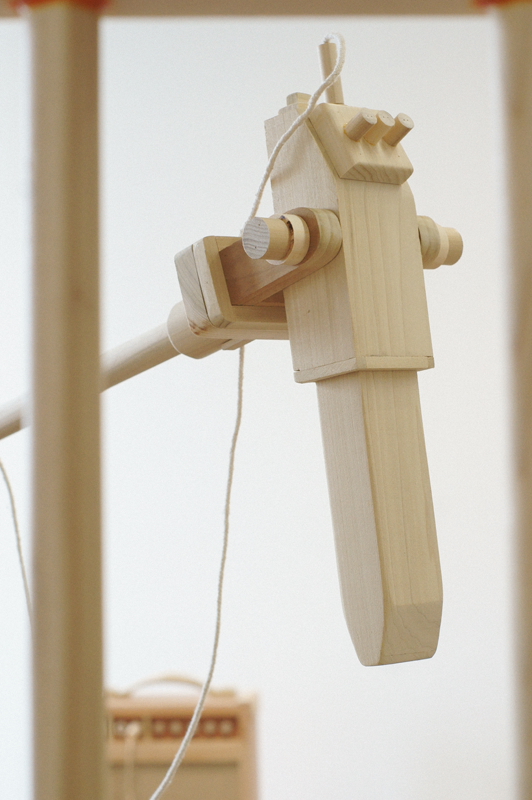
| Above: The Robert Grosvenor exhibition, February 11 - April 9, 2017, in the Renaissance Society at the University of Chicago, Bergman Gallery, Cobb Hall 418, 5811 S. Ellis Ave., Chicago, IL. |
February 11 - April 9, 2017
The Renaissance Society
5811 S. Ellis Avenue
Bergman Gallery, Cobb Hall 418
Chicago, IL
http://www.renaissancesociety.org/
Said to have been founded by refugees from violence at Oxford in 1209,[1][2] the University of Cambridge was enlarged by the establishment of Pembroke College in 1347.[3] Some 280 years later, in 1627, Pembroke, Cambridge, graduated an Englishman named Roger Williams.[4] Seeking religious liberty at least, Williams left Britain and traveled to the New World city of Boston in 1631.[5] There, Williams' beliefs, and friendliness with some Native American people, seem to have contributed to: his exile from Massachusetts in 1635;[6] the founding of the City of Providence in 1636;[7][8] the establishment of First Baptist Church in America in 1638;[9][10] and, the charter of the Colony of Rhode Island in 1644.[11]
Among other early leaders of the First Baptist Church in America was one Rev. Chad Brown,[12] whose family in 1804 gave its surname to a college that the Philadelphia Association of Baptist Churches had been instrumental in creating: Brown University, in Providence, Rhode Island.[13] Ten years later, in 1814, the first General Missionary Convention of the Baptist Denomination in the United States was gathered at Philadelphia, Pennsylvania.[14] And, over time, that national convocation organized and extended its work through the formation of subsidiary groups, including, in 1888, the American Baptist Education Society.[15][16]
In 1890, the American Baptist Education Society,[17] with a financial donation made by John D. Rockefeller, and land provided by Marshall Field, helped to build the University of Chicago.[18]
 |
| Above: A portrait of Silas B. Cobb (January 23, 1812 - April 5, 1900) courtesy of the University of Chicago Photographic Archive; image assumed to be public domain in the United States because it was published (or registered with the U.S. Copyright Office) before January 1, 1923; presented here in support of an original, scholarly work. See more at Image (2), below. |
 |
| Above: The northern portion of Cobb Lecture Hall (sometime between 1900 and 1915) at the University of Chicago, on Ellis Ave., in Chicago, IL, courtesy of the Library of Congress; image assumed to be public domain in the United States because it was published (or registered with the U.S. Copyright Office) before January 1, 1923; presented here in support of an original, scholarly work. See more at Image (3), below. |
 |
| Above: The entrance to Cobb Hall from the (east) main quadrangle at the University of Chicago, on the night of March 1, 2017. |
 |
| Above: Immediately inside the main entrance to Cobb Hall at the University of Chicago, on the night of March 1, 2017. |
Older than Rome, older than Greece, is the hope to extend the memory of one's existence through some participation in the arts and architecture.
 |
| Above: What appears to be a bronze bust of Silas B. Cobb, found ensconced in the main stairwell of the eponymous benefactor's building at the University of Chicago, on the night of March 1, 2017. |
For a forty-year period of the museum's history, from 1974 to 2013, Susanne Ghez served as its executive director and chief curator.[29] And for over twenty years, from 1994 to 2016, Hamza Walker, in his capacity as associate curator and director of education, shaped the institution's public engagement by means of interpretive essays, tours, and interviews, as they were offered alongside hosted artists' presentations.[30]
Lacking a permanent collection, it follows that otherwise ancillary writing, speeches, and documentation have become elevated in their importance; such things, collectively, constitute the sole archive available to the critic, curator, and historian.
 |
| Above: The hallway leading to the Renaissance Society at the University of Chicago, located on the fourth floor of Cobb Hall, 5811 S. Ellis Ave., Chicago, IL. Past publications at left; printed material for current exhibition found on glass table at right. |
 |
| Above: A pamphlet created for the Robert Grosvenor exhibition, February 11 - April 9, 2017, in the Renaissance Society at the University of Chicago, Bergman Gallery, Cobb Hall 418, 5811 S. Ellis Ave., Chicago, IL. |
That physical description, above, should remind Renaissance Society patrons of Kathryn Andrews' 2010 work "Friends and Lovers" from "Teen Paranormal Romance" which was on display exactly three years ago: March 9 - April 13, 2014.[35][36]
 |
| Above: A slide presentation beginning the Robert Grosvenor exhibition walk-through with curator Solveig Øvstebø, 6:00 PM, March 1, 2017, in the Renaissance Society at the University of Chicago, Bergman Gallery, Cobb Hall 418, 5811 S. Ellis Ave., Chicago, IL. |
 |
| Above: The Robert Grosvenor exhibition walk-through with curator Solveig Øvstebø, 6:00 PM, March 1, 2017, in the Renaissance Society at the University of Chicago, Bergman Gallery, Cobb Hall 418, 5811 S. Ellis Ave., Chicago, IL. |
Promotional material created for the exhibition communicates that Grosvenor's sculpture has been "re-contextualized within a spare architectural installation," which might be true if one considers only the white walls surrounding the untitled piece. But the Ren's Bergman Gallery occupies just one room within Cobb Hall. And Cobb Hall is not a nondescript warehouse or factory from which space has been reclaimed.
No. Cobb Hall is, by American standards, an old academic building--employing elements of the English Gothic style in order to appear to be an even older academic building. And it isn't possible to see anything inside the Ren without first seeing the facade of Cobb Hall. Even if a person were to be led blindfolded into the gallery, visible therein is a radically angular ceiling whose shape has been inversely determined by the roof of Cobb Hall; it's quite striking, recalling the lines of the work for which Grosvenor is better known.[37]
 |
| Above: The Robert Grosvenor exhibition walk-through with curator Solveig Øvstebø, 6:00 PM, March 1, 2017, in the Renaissance Society at the University of Chicago, Bergman Gallery, Cobb Hall 418, 5811 S. Ellis Ave., Chicago, IL. |
Speaking of another untitled piece, and the practice of masonry, while treating Grosvenor's April 25 - June 26, 2015 exhibition at Paula Cooper Gallery, New York, NY, Yau offered the following in the Brooklyn-based on-line art magazine Hyperallergic on May 10, 2015:
"...in 'Untitled' and related pieces, Grosvenor wanted to evoke the anonymous worker, dating back to the ones who built the Pyramid at Giza and including the masons who built the brick wall on Prince Street. The evidence of their labor is simultaneously mute and eloquent, while telling us almost nothing of their vanished lives."[38]
And again, when invited to speak at the February 11, 2017 opening for Grosvenor's exhibition at the Renaissance Society, Yau restated, practically verbatim, the position that he took in Hyperallergic almost two years earlier.[39]
 |
| Above: The Robert Grosvenor exhibition walk-through with curator Solveig Øvstebø, 6:00 PM, March 1, 2017, in the Renaissance Society at the University of Chicago, Bergman Gallery, Cobb Hall 418, 5811 S. Ellis Ave., Chicago, IL. |
The pyramid builders were not anonymous.[40][41][42][43] Conjuring an image of slavish laborers who were "mute and eloquent...telling us almost nothing of their vanished lives," might be at once poetic and also politically expedient. But, as a matter of fact, it just can't be squared with the archaeological record. Then, as now, workmen, both deliberately and also accidentally, incorporated evidence of their involvement in great undertakings.
Ironically, in contrast to the Great Pyramid and Cobb Hall, the untitled artwork on display in the Renaissance Society, which has been said to point towards a concern with anonymous labor, probably owes any attention it receives to the name of the person who caused it to be made, as the thing itself is not in any other way remarkable.
 |
| Above: The Robert Grosvenor exhibition, February 11 - April 9, 2017, in the Renaissance Society at the University of Chicago, Bergman Gallery, Cobb Hall 418, 5811 S. Ellis Ave., Chicago, IL. |
"Can the work once again rise to the occasion of absorbing the numerous anxieties reflected in today’s refugee crisis, border debates involving the United States and Mexico, and workers’ rights violations of those responsible for the construction of iconic architecture worldwide? Let the anonymous hands of those involved in these struggles be revealed within Grosvenor’s concrete blocks, and may shelter be sought under the steel roof and within the space between these two walls."[44]
Joseph doesn't cite Yau, but she does echo his concerns for class and labor: Yau's "anonymous workers" building the "Pyramid at Giza," have become Joseph's "anonymous hands" constructing "iconic architecture," and so on.
 |
| Above: The Robert Grosvenor exhibition, February 11 - April 9, 2017, in the Renaissance Society at the University of Chicago, Bergman Gallery, Cobb Hall 418, 5811 S. Ellis Ave., Chicago, IL. |
Considering the earlier comparison of Robert Grosvenor to Kathryn Andrews, it seems noteworthy that Andrews' sculpture had no political message imputed to it by a critic. Why? Andrews literally ran a fence around concrete block walls imprinted with cartoon renditions of happiness, and there was no suggestion in the press that such a thing might be interpreted as representing: (a) the inaccessibility of what was imagined to be desirable; or, (b) the purposeful delimiting of a worldview; etc..
 |
| Above: The Robert Grosvenor exhibition, February 11 - April 9, 2017, in the Renaissance Society at the University of Chicago, Bergman Gallery, Cobb Hall 418, 5811 S. Ellis Ave., Chicago, IL. |
Opposite the aforementioned cement hut there stands a scooter, the best possible purpose for which is movement beyond the cloister suggested by its static counterpart. In the end, the piece offers two choices to its viewer: (1) to hunker down; or, (2) to move and see. Not surprisingly, the scooter tends to be neglected.
 |
| Above: The Robert Grosvenor exhibition, February 11 - April 9, 2017, in the Renaissance Society at the University of Chicago, Bergman Gallery, Cobb Hall 418, 5811 S. Ellis Ave., Chicago, IL. |
[1] https://www.cam.ac.uk/about-the-university/history/early-records
[2] http://www.cl.cam.ac.uk/~rja14/unauthorised.html
[3] http://www.pem.cam.ac.uk/the-college/
"Pembroke College, founded in 1347 by Marie de St Pol, Countess of Pembroke..."
[4] https://www.nps.gov/rowi/learn/historyculture/youth.htm
[5] https://www.nps.gov/rowi/learn/historyculture/departure.htm
[6] Ibid.
[7] http://www.rootsweb.ancestry.com/~rigenweb/Providence/article271.html
The text above seems to be from pages 253-259 of "History of the State of Rhode Island: With Illustrations from Original Sketches" originally published in Philadelphia by Hoag, Wade & Co., 1878.
[8] https://www.nps.gov/rowi/learn/historyculture/verincase.htm
[9] http://www.abc-usa.org/2012/03/22/first-baptist-church-in-america-providence-ri/
[10] https://www.brown.edu/cis/sta/dev/providence_architecture/locations/college_hill/first_baptist_meeting_house/
[11] https://law.rwu.edu/sites/law/files/rwu/Library/pdf/rhode_island_gw_0104.pdf
Gail I. Winson: "In 1643 Roger Williams traveled to England to obtain a charter which would authorize the towns of Providence, Portsmouth, and Newport to form a colony. At this point England was in turmoil; King Charles I had fled London, and Parliament was ruling without a monarch. [...] Williams obtained this first charter from the Parliamentary Commissioners for Plantations [...] The Charter of 1644 legitimized the settlers’ claims to land..."
[12] https://books.google.com/books?id=El0EAAAAYAAJ&printsec=frontcover&source=gbs_ge_summary_r&cad=0#v=onepage&q&f=false
Thomas Williams Bicknell: "...Chad Brown, who was the first ordained pastor of the First Baptist Church in Providence."
The quotation above seems to be from page 283 of the first volume of Thomas Williams Bicknell's "The History of the State of Rhode Island and Providence Plantations" originally published in New York by The American Historical Society, 1920.
[13] https://www.brown.edu/web/documents/short-history-of-brown.pdf
Janet M. Phillips: "Nicholas Brown’s gift of $5,000 to endow a chair in oratory carried out the wishes of his recently deceased uncle, John Brown, and was the first in a series of increasingly liberal gifts over his lifetime. [...] In September 1804, at the same meeting in which the gift was announced, the Corporation voted to change the college’s name to 'Brown University in Providence in the State of Rhode Island, and Providence Plantations.'"
The quotation above seems to be from page 37 of Janet M. Phillips' "Brown University, a Short History" originally published in Providence, Rhode Island, by Brown University, 1992.
[14] https://www.lutherrice.edu/about-us/the-man-luther-rice.cms
"...Baptists met for their first national meeting at Philadelphia in 1814. It was called 'The General Missionary Convention of the Baptist Denomination in United States of America, for Foreign Missions.' Since the convention would meet every three years it came simply to be called the 'Triennial Convention.'"
Find the quotation above between [13] and [14] in the body of the text "History of the Man Named Luther Rice" published on-line by Luther Rice College & Seminary.
"Baptist Page Articles are offered as a service to the readers of The Baptist Page. You are given permission to reprint this in any form available. We only ask that this paragraph remain with the article. biorice.htm: Part of http://www.tlogical.net Copyright (C) 2005 John M. Fritzius"
[15] http://abhsarchives.org/wp-content/uploads/2014/07/Denominations-Archives-list-on-web-site.pdf
[16] https://www.lib.uchicago.edu/e/scrc/findingaids/view.php?eadid=ICU.SPCL.BAPTISTEDU
[17] Ibid.
[18] http://www.uchicago.edu/about/history/
[19] https://www.lib.uchicago.edu/e/webexhibits/building/buildings.html
"The safety net created by John D. Rockefeller's largesse, always given with careful deliberation, was both supportive and prescriptive, supportive in the sense that his gifts underwrote current academic operations and provided for long-term endowment, but prescriptive because Rockefeller insisted that his money should not be used to erect buildings."
[20] https://books.google.com/books?id=5wgTAAAAYAAJ&pg=RA1-PA56&lpg=RA1-PA56&dq=university+of+chicago+Cobb+Lecture+Hall+four+stories&source=bl&ots=ElBg7nChsO&sig=h4iWNmgFTMXY_wrH1IuVGxh-nv0&hl=en&sa=X&ved=0ahUKEwi18fyfhsHSAhVDSyYKHYiJDt4Q6AEIQTAH#v=onepage&q=university%20of%20chicago%20Cobb%20Lecture%20Hall%20four%20stories&f=false
The text above (in which Silas Bowman Cobb announces his donation) seems to be from June 9, 1892, as found published in "The University of Chicago Magazine" Volumes 5-6, in 1919.
[21] Ibid.
[22] http://architecture.uchicago.edu/locations/cobb_lecture_hall/
[23] Ibid.
[24] https://www.theatlantic.com/education/archive/2013/09/how-gothic-architecture-took-over-the-american-college-campus/279287/
See the eighth paragraph from the bottom in "How Gothic Architecture Took Over the American College Campus" by Robinson Meyer, The Atlantic, September 11, 2013, linked above.
[25] http://www.renaissancesociety.org/about/
[26] http://architecture.uchicago.edu/locations/cobb_lecture_hall/
[27] http://classics.mit.edu/Thucydides/pelopwar.6.sixth.html
See "Affair of the Hermae" 415 BC, 17th year of the Peloponnesian War (sometimes found 6.27 - 6.29) in Book Six of Thucydides' "History of the Peloponnesian War".
[28] https://sites.google.com/site/neoherm/
See above University of Chicago student/s recreating "Affair of the Hermae" in 2008. See additional photographic documentation (Cobb Hall sometimes visible in the background) here:
https://www.flickr.com/photos/88388884@N00/sets/72157594536634616/
[29] https://dova.uchicago.edu/faculty/ghez
[30] http://sixtyinchesfromcenter.org/between-chapters-an-exit-interview-with-hamza-walker/
Hamza Walker to Tempestt Hazel: "But with the publication cycle and press coverage, I felt you needed to take matters into your own hands. [This meant] not just writing a press release and issuing it, but not waiting for someone to interpret the show. I started to write, in-house [at the Renaissance Society], about what was going on with the shows. Period. If you thought the press was going to be your output, [that probably wasn’t going to happen]."
[31] https://arts.uchicago.edu/article/renaissance-society-names-solveig-%C3%B8vsteb%C3%B8-first-new-executive-director-nearly-40-years
[32] http://www.chicagogallerynews.com/news/2014/1/solveig-ovstebo-at-the-renaissance-society
[33] http://chicagoartworld.blogspot.com/2014/01/2014-nora-schultz-renaissance-society.html
[34] http://www.renaissancesociety.org/exhibitions/526/robert-grosvenor/
[35] http://chicagoartworld.blogspot.com/2014/04/2014-teen-paranormal-romance.html
[36] http://sfaq.us/2014/03/sfaq-review-teen-paranormal-romance-curated-by-hamza-walker-at-the-renaissance-society-chicago/
[37] https://www.youtube.com/watch?v=fezrdtH6MNE
Above: In a video uploaded to YouTube on May 6, 2011, curator Scott Rothkopf discusses Grosvenor’s 1966 "Tenerife" from the exhibition "Singular Visions" at the Whitney Museum of American Art, December 16, 2010 - August 5, 2012.
[38] http://hyperallergic.com/205633/robert-grosvenor-and-the-anonymous-laborer/
[39] https://vimeo.com/203888018
[40] http://www.bbc.co.uk/history/ancient/egyptians/pyramid_builders_01.shtml
"At Giza the workforce was divided into crews of approximately 2,000 and then sub-divided into named gangs of 1,000: graffiti show that the builders of the third Giza pyramid named themselves the 'Friends of Menkaure' and the 'Drunkards of Menkaure'."
[41] http://harvardmagazine.com/2003/07/who-built-the-pyramids-html
[42] http://articles.latimes.com/1991-03-10/news/mn-295_1_pyramid-builders
[43] http://anthropology.msu.edu/anp363-ss13/2013/02/27/graffiti-in-the-giza-pyramids/
[44] http://art.newcity.com/2017/03/28/if-these-walls-could-talk/
[45] http://www.chicagotribune.com/entertainment/ct-kerry-james-marshall-coty-art-20161222-column.html
Lori Waxman: "...a year when black bodies have been placed ever more under siege,"
The language of (race) war is used in the arts and art criticism too.
Images:
Images (1, 4-16) March 1, 2017, Copyright Paul E. Germanos;
Image (2) Found in Wikimedia Commons with supplemental information as follows:
Location: https://commons.wikimedia.org/wiki/File:Silas_B._Cobb.jpg
Description: Portrait of Silas B. Cobb, courtesy: University of Chicago Photographic Archive
Date: Unknown date
Source: http://photoarchive.lib.uchicago.edu/db.xqy?one=apf1-01724.xml
Author: University of Chicago Photographic Archive
Licensing: This work is in the public domain in the United States because it was published (or registered with the U.S. Copyright Office) before January 1, 1923.
Caveat: Images in the University of Chicago Photographic Archive may be used for educational and scholarly purposes, but any such use requires that a credit line be included with any image used.
Image (3) Found in Library of Congress with supplemental information as follows:
Location: https://www.loc.gov/item/det1994016964/PP/
Title: Cobb Lecture Hall, University of Chicago, Chicago, Il
Contributor Names: Behm, Hans, photographer; Detroit Publishing Co., publisher
Created / Published: between 1900 and 1915
Notes: Title from jacket; "Behm" and "extra" on negative; Detroit Publishing Co. no. 039419; Gift; State Historical Society of Colorado; 1949
Medium: 1 negative : glass ; 8 x 10 in.
Call Number/Physical Location: LC-D4-39419 [P&P]
Source Collection: Detroit Publishing Company Photograph Collection
Repository: Library of Congress Prints and Photographs Division Washington, D.C. 20540 USA
Digital Id: det 4a19708 //hdl.loc.gov/loc.pnp/det.4a19708
Control Number: det1994016964/PP
Reproduction Number: LC-DIG-det-4a19708 (digital file from original)
Rights Advisory: No known restrictions on publication