Showing posts with label University of Chicago. Show all posts

April 5, 2017

2017: Robert Grosvenor @ Renaissance Society

Above: The Robert Grosvenor exhibition, February 11 - April 9, 2017, in the Renaissance Society at the University of Chicago, Bergman Gallery, Cobb Hall 418, 5811 S. Ellis Ave., Chicago, IL.
Robert Grosvenor
February 11 - April 9, 2017
The Renaissance Society
5811 S. Ellis Avenue
Bergman Gallery, Cobb Hall 418
Chicago, IL

http://www.renaissancesociety.org/

Said to have been founded by refugees from violence at Oxford in 1209,[1][2] the University of Cambridge was enlarged by the establishment of Pembroke College in 1347.[3] Some 280 years later, in 1627, Pembroke, Cambridge, graduated an Englishman named Roger Williams.[4] Seeking religious liberty at least, Williams left Britain and traveled to the New World city of Boston in 1631.[5] There, Williams' beliefs, and friendliness with some Native American people, seem to have contributed to: his exile from Massachusetts in 1635;[6] the founding of the City of Providence in 1636;[7][8] the establishment of First Baptist Church in America in 1638;[9][10] and, the charter of the Colony of Rhode Island in 1644.[11]

Among other early leaders of the First Baptist Church in America was one Rev. Chad Brown,[12] whose family in 1804 gave its surname to a college that the Philadelphia Association of Baptist Churches had been instrumental in creating: Brown University, in Providence, Rhode Island.[13] Ten years later, in 1814, the first General Missionary Convention of the Baptist Denomination in the United States was gathered at Philadelphia, Pennsylvania.[14] And, over time, that national convocation organized and extended its work through the formation of subsidiary groups, including, in 1888, the American Baptist Education Society.[15][16]

In 1890, the American Baptist Education Society,[17] with a financial donation made by John D. Rockefeller, and land provided by Marshall Field, helped to build the University of Chicago.[18]

Above: A portrait of Silas B. Cobb (January 23, 1812 - April 5, 1900) courtesy of the University of Chicago Photographic Archive; image assumed to be public domain in the United States because it was published (or registered with the U.S. Copyright Office) before January 1, 1923; presented here in support of an original, scholarly work. See more at Image (2), below.
Maybe telling of its inaugural president--William Rainey Harper--construction of the young school's central lecture hall began before funding for it was obtained; Rockefeller had stipulated that money for infrastructure was to be found locally, not in his beneficence.[19] Fortunately, in June of 1892, a wealthy Chicagoan named Silas Bowman Cobb rose to the occasion.[20] And what was thereafter known as "Cobb Lecture Hall" became, in October of 1892, the first building to be completed on campus.[21][22]

Above: The northern portion of Cobb Lecture Hall (sometime between 1900 and 1915) at the University of Chicago, on Ellis Ave., in Chicago, IL, courtesy of the Library of Congress; image assumed to be public domain in the United States because it was published (or registered with the U.S. Copyright Office) before January 1, 1923; presented here in support of an original, scholarly work. See more at Image (3), below.
Cobb Hall was designed to recall the sort of English Gothic work that, when taken together with its neighbors and quadrangle, was suggestive of Oxford University.[23][24] And with mention of Oxford the reader is brought back to the first paragraph of this article, which must have seemed an odd place to begin to examine an artwork on display at the Renaissance Society.

Above: The entrance to Cobb Hall from the (east) main quadrangle at the University of Chicago, on the night of March 1, 2017.
The Renaissance Society itself was founded in 1915,[25] 25 years after the inception of the University of Chicago. Today, the "Ren," colloquially, occupies the northern end of the top floor of Cobb Hall; the remainder of the four-story building is given over to studies in the social sciences and humanities.[26]

Above: Immediately inside the main entrance to Cobb Hall at the University of Chicago, on the night of March 1, 2017.
Everyone who utilizes Cobb's (evidently remodeled) main stairwell passes under the unblinking eyes of the man himself, as his likeness is perched on the eastern wall. Cobb within Cobb there suffers whatever indignity chances upon him: cobwebs; dust; pigeon droppings; paint; small bits of saliva-wetted paper, balled and hurled by undergraduate students; etc.. Whether disrespectful, the behavior isn't novel: Alcibiades was accused of having done worse to the gods of his own people.[27][28] And isn't the presentation of a bronze figure with a patina meant to be evocative of classical antiquity?

Older than Rome, older than Greece, is the hope to extend the memory of one's existence through some participation in the arts and architecture.

Above: What appears to be a bronze bust of Silas B. Cobb, found ensconced in the main stairwell of the eponymous benefactor's building at the University of Chicago, on the night of March 1, 2017.
Contemporary art is said to be the concern of the one hundred and two year-old Renaissance Society. Distinctively, that concern is addressed through a program of exhibitions, talks, publications, and performances, rather than through the accumulation of objects.

For a forty-year period of the museum's history, from 1974 to 2013, Susanne Ghez served as its executive director and chief curator.[29] And for over twenty years, from 1994 to 2016, Hamza Walker, in his capacity as associate curator and director of education, shaped the institution's public engagement by means of interpretive essays, tours, and interviews, as they were offered alongside hosted artists' presentations.[30]

Lacking a permanent collection, it follows that otherwise ancillary writing, speeches, and documentation have become elevated in their importance; such things, collectively, constitute the sole archive available to the critic, curator, and historian.

Above: The hallway leading to the Renaissance Society at the University of Chicago, located on the fourth floor of Cobb Hall, 5811 S. Ellis Ave., Chicago, IL. Past publications at left; printed material for current exhibition found on glass table at right.
In 2013 the Ren's mantle was passed from Susanne Ghez to Bergen, Norway's Solveig Øvstebø, the present executive director and chief curator.[31][32] The current exhibition, "Robert Grosvenor," seems to be the thirteenth under Øvstebø, whose own production began with Nora Schultz's "parrottree -- building for bigger than real," on January 11, 2014.[33]

Above: A pamphlet created for the Robert Grosvenor exhibition, February 11 - April 9, 2017, in the Renaissance Society at the University of Chicago, Bergman Gallery, Cobb Hall 418, 5811 S. Ellis Ave., Chicago, IL.
Here, now, Robert Grosvenor presents a single sculptural work, untitled, from 1989-1990.[34] It's composed, mostly, of concrete blocks: each block coated with metallic paint and set, dry, in one of two opposing walls; each wall being six units (or courses) high, and eleven units long.

That physical description, above, should remind Renaissance Society patrons of Kathryn Andrews' 2010 work "Friends and Lovers" from "Teen Paranormal Romance" which was on display exactly three years ago: March 9 - April 13, 2014.[35][36]

Above: A slide presentation beginning the Robert Grosvenor exhibition walk-through with curator Solveig Øvstebø, 6:00 PM, March 1, 2017, in the Renaissance Society at the University of Chicago, Bergman Gallery, Cobb Hall 418, 5811 S. Ellis Ave., Chicago, IL.
Having written that, Andrews prevented immediate access to her masonry structures by means of an extensive steel fence run around said objects' perimeter, whereas the ferrous components of Grosvenor's installation--a few corrugated metal sheets over supporting stock--only bridge the short distance between the walls he's erected. Consequently, while Andrews' artwork took the form of a closed courtyard, Grosvenor's presents itself as an "open-ended" little building.

Above: The Robert Grosvenor exhibition walk-through with curator Solveig Øvstebø, 6:00 PM, March 1, 2017, in the Renaissance Society at the University of Chicago, Bergman Gallery, Cobb Hall 418, 5811 S. Ellis Ave., Chicago, IL.
Essentially, Grosvenor has chosen to show a piece of architecture within a piece of architecture. In this setting the artwork's viewers encounter walls within walls, and a roof under a roof. Is that nested placement a matter of consequence?

Promotional material created for the exhibition communicates that Grosvenor's sculpture has been "re-contextualized within a spare architectural installation," which might be true if one considers only the white walls surrounding the untitled piece. But the Ren's Bergman Gallery occupies just one room within Cobb Hall. And Cobb Hall is not a nondescript warehouse or factory from which space has been reclaimed.

No. Cobb Hall is, by American standards, an old academic building--employing elements of the English Gothic style in order to appear to be an even older academic building. And it isn't possible to see anything inside the Ren without first seeing the facade of Cobb Hall. Even if a person were to be led blindfolded into the gallery, visible therein is a radically angular ceiling whose shape has been inversely determined by the roof of Cobb Hall; it's quite striking, recalling the lines of the work for which Grosvenor is better known.[37]

Above: The Robert Grosvenor exhibition walk-through with curator Solveig Øvstebø, 6:00 PM, March 1, 2017, in the Renaissance Society at the University of Chicago, Bergman Gallery, Cobb Hall 418, 5811 S. Ellis Ave., Chicago, IL.
It seems reasonable to assume that Grosvenor's notoriety helped to ease his work into the museum. And, if true, that complicates critic John Yau's efforts to connect Grosvenor's practice to a concern for anonymous labor.

Speaking of another untitled piece, and the practice of masonry, while treating Grosvenor's April 25 - June 26, 2015 exhibition at Paula Cooper Gallery, New York, NY, Yau offered the following in the Brooklyn-based on-line art magazine Hyperallergic on May 10, 2015:

"...in 'Untitled' and related pieces, Grosvenor wanted to evoke the anonymous worker, dating back to the ones who built the Pyramid at Giza and including the masons who built the brick wall on Prince Street. The evidence of their labor is simultaneously mute and eloquent, while telling us almost nothing of their vanished lives."[38]

And again, when invited to speak at the February 11, 2017 opening for Grosvenor's exhibition at the Renaissance Society, Yau restated, practically verbatim, the position that he took in Hyperallergic almost two years earlier.[39]

Above: The Robert Grosvenor exhibition walk-through with curator Solveig Øvstebø, 6:00 PM, March 1, 2017, in the Renaissance Society at the University of Chicago, Bergman Gallery, Cobb Hall 418, 5811 S. Ellis Ave., Chicago, IL.
Of course, the Great Pyramid of Giza has another name: it's commonly referred to as the Pyramid of Khufu. The Great Pyramid bears the name of the Pharaoh Khufu--even as Cobb Hall bears the name of Silas B. Cobb. Again, the hope to extend the memory of one's existence through some participation in the arts and architecture seems to be one durable facet of human nature. And that's true irrespective of social hierarchy.

The pyramid builders were not anonymous.[40][41][42][43] Conjuring an image of slavish laborers who were "mute and eloquent...telling us almost nothing of their vanished lives," might be at once poetic and also politically expedient. But, as a matter of fact, it just can't be squared with the archaeological record. Then, as now, workmen, both deliberately and also accidentally, incorporated evidence of their involvement in great undertakings.

Ironically, in contrast to the Great Pyramid and Cobb Hall, the untitled artwork on display in the Renaissance Society, which has been said to point towards a concern with anonymous labor, probably owes any attention it receives to the name of the person who caused it to be made, as the thing itself is not in any other way remarkable.

Above: The Robert Grosvenor exhibition, February 11 - April 9, 2017, in the Renaissance Society at the University of Chicago, Bergman Gallery, Cobb Hall 418, 5811 S. Ellis Ave., Chicago, IL.
Closer to home, Denise Joseph closes her March 28, 2017, Newcity review of Robert Grosvenor at the Renaissance Society with the following words:

"Can the work once again rise to the occasion of absorbing the numerous anxieties reflected in today’s refugee crisis, border debates involving the United States and Mexico, and workers’ rights violations of those responsible for the construction of iconic architecture worldwide? Let the anonymous hands of those involved in these struggles be revealed within Grosvenor’s concrete blocks, and may shelter be sought under the steel roof and within the space between these two walls."[44]

Joseph doesn't cite Yau, but she does echo his concerns for class and labor: Yau's "anonymous workers" building the "Pyramid at Giza," have become Joseph's "anonymous hands" constructing "iconic architecture," and so on.

Above: The Robert Grosvenor exhibition, February 11 - April 9, 2017, in the Renaissance Society at the University of Chicago, Bergman Gallery, Cobb Hall 418, 5811 S. Ellis Ave., Chicago, IL.
And so it bears repeating that Grosvenor could, but does not, conduct his practice anonymously. He is known for his work; his works are known for their connection to his person. And being a part of the historical record because of what he's built, it's easier to tease out a relationship between Grosvenor, Cobb, and Khufu, than between Grosvenor and any unknown worker.

Considering the earlier comparison of Robert Grosvenor to Kathryn Andrews, it seems noteworthy that Andrews' sculpture had no political message imputed to it by a critic. Why? Andrews literally ran a fence around concrete block walls imprinted with cartoon renditions of happiness, and there was no suggestion in the press that such a thing might be interpreted as representing: (a) the inaccessibility of what was imagined to be desirable; or, (b) the purposeful delimiting of a worldview; etc..

Above: The Robert Grosvenor exhibition, February 11 - April 9, 2017, in the Renaissance Society at the University of Chicago, Bergman Gallery, Cobb Hall 418, 5811 S. Ellis Ave., Chicago, IL.
Maybe, the exhibition of Grosvenor's untitled sculpture is a reminder of the "bunker mentality" that now possesses the nation. Politically, much has passed since "Teen Paranormal Romance" was on display at the Ren three years ago. So much so, that, as if dwelling in one of the walled cities of the Medieval Period, many present-day Americans complain they live under siege.[45] Within federal, state, county, and municipal boundaries, the people have the appearance of being increasingly divided by race, gender, sexual orientation, religion, and such, their capacity to speak and listen to one another, in a polite manner, proportionally diminished. Walls within walls have been, and are still being, erected.

Opposite the aforementioned cement hut there stands a scooter, the best possible purpose for which is movement beyond the cloister suggested by its static counterpart. In the end, the piece offers two choices to its viewer: (1) to hunker down; or, (2) to move and see. Not surprisingly, the scooter tends to be neglected.

Above: The Robert Grosvenor exhibition, February 11 - April 9, 2017, in the Renaissance Society at the University of Chicago, Bergman Gallery, Cobb Hall 418, 5811 S. Ellis Ave., Chicago, IL.
Notes:

[1] https://www.cam.ac.uk/about-the-university/history/early-records

[2] http://www.cl.cam.ac.uk/~rja14/unauthorised.html

[3] http://www.pem.cam.ac.uk/the-college/

"Pembroke College, founded in 1347 by Marie de St Pol, Countess of Pembroke..."

[4] https://www.nps.gov/rowi/learn/historyculture/youth.htm

[5] https://www.nps.gov/rowi/learn/historyculture/departure.htm

[6] Ibid.

[7] http://www.rootsweb.ancestry.com/~rigenweb/Providence/article271.html

The text above seems to be from pages 253-259 of "History of the State of Rhode Island: With Illustrations from Original Sketches" originally published in Philadelphia by Hoag, Wade & Co., 1878.

[8] https://www.nps.gov/rowi/learn/historyculture/verincase.htm

[9] http://www.abc-usa.org/2012/03/22/first-baptist-church-in-america-providence-ri/

[10] https://www.brown.edu/cis/sta/dev/providence_architecture/locations/college_hill/first_baptist_meeting_house/

[11] https://law.rwu.edu/sites/law/files/rwu/Library/pdf/rhode_island_gw_0104.pdf

Gail I. Winson: "In 1643 Roger Williams traveled to England to obtain a charter which would authorize the towns of Providence, Portsmouth, and Newport to form a colony. At this point England was in turmoil; King Charles I had fled London, and Parliament was ruling without a monarch. [...] Williams obtained this first charter from the Parliamentary Commissioners for Plantations [...] The Charter of 1644 legitimized the settlers’ claims to land..."

[12] https://books.google.com/books?id=El0EAAAAYAAJ&printsec=frontcover&source=gbs_ge_summary_r&cad=0#v=onepage&q&f=false

Thomas Williams Bicknell: "...Chad Brown, who was the first ordained pastor of the First Baptist Church in Providence."

The quotation above seems to be from page 283 of the first volume of Thomas Williams Bicknell's "The History of the State of Rhode Island and Providence Plantations" originally published in New York by The American Historical Society, 1920.

[13] https://www.brown.edu/web/documents/short-history-of-brown.pdf

Janet M. Phillips: "Nicholas Brown’s gift of $5,000 to endow a chair in oratory carried out the wishes of his recently deceased uncle, John  Brown, and was the first in a series of increasingly liberal gifts over his lifetime. [...] In September 1804, at the same meeting in which the gift was announced, the Corporation voted to change the college’s name to 'Brown University in Providence in the State of Rhode Island, and Providence Plantations.'"

The quotation above seems to be from page 37 of Janet M. Phillips' "Brown University, a Short History" originally published in Providence, Rhode Island, by Brown University, 1992.

[14] https://www.lutherrice.edu/about-us/the-man-luther-rice.cms

"...Baptists met for their first national meeting at Philadelphia in 1814. It was called 'The General Missionary Convention of the Baptist Denomination in United States of America, for Foreign Missions.' Since the convention would meet every three years it came simply to be called the 'Triennial Convention.'"

Find the quotation above between [13] and [14] in the body of the text "History of the Man Named Luther Rice" published on-line by Luther Rice College & Seminary.

"Baptist Page Articles are offered as a service to the readers of The Baptist Page. You are given permission to reprint this in any form available. We only ask that this paragraph remain with the article.  biorice.htm: Part of http://www.tlogical.net Copyright (C) 2005 John M. Fritzius"

[15] http://abhsarchives.org/wp-content/uploads/2014/07/Denominations-Archives-list-on-web-site.pdf

[16] https://www.lib.uchicago.edu/e/scrc/findingaids/view.php?eadid=ICU.SPCL.BAPTISTEDU

[17] Ibid.

[18] http://www.uchicago.edu/about/history/

[19] https://www.lib.uchicago.edu/e/webexhibits/building/buildings.html

"The safety net created by John D. Rockefeller's largesse, always given with careful deliberation, was both supportive and prescriptive, supportive in the sense that his gifts underwrote current academic operations and provided for long-term endowment, but prescriptive because Rockefeller insisted that his money should not be used to erect buildings."

[20] https://books.google.com/books?id=5wgTAAAAYAAJ&pg=RA1-PA56&lpg=RA1-PA56&dq=university+of+chicago+Cobb+Lecture+Hall+four+stories&source=bl&ots=ElBg7nChsO&sig=h4iWNmgFTMXY_wrH1IuVGxh-nv0&hl=en&sa=X&ved=0ahUKEwi18fyfhsHSAhVDSyYKHYiJDt4Q6AEIQTAH#v=onepage&q=university%20of%20chicago%20Cobb%20Lecture%20Hall%20four%20stories&f=false

The text above (in which Silas Bowman Cobb announces his donation) seems to be from June 9, 1892, as found published in "The University of Chicago Magazine" Volumes 5-6, in 1919.

[21] Ibid.

[22] http://architecture.uchicago.edu/locations/cobb_lecture_hall/

[23] Ibid.

[24] https://www.theatlantic.com/education/archive/2013/09/how-gothic-architecture-took-over-the-american-college-campus/279287/

See the eighth paragraph from the bottom in "How Gothic Architecture Took Over the American College Campus" by Robinson Meyer, The Atlantic, September 11, 2013, linked above.

[25] http://www.renaissancesociety.org/about/

[26] http://architecture.uchicago.edu/locations/cobb_lecture_hall/

[27] http://classics.mit.edu/Thucydides/pelopwar.6.sixth.html

See "Affair of the Hermae" 415 BC, 17th year of the Peloponnesian War (sometimes found 6.27 - 6.29) in Book Six of Thucydides' "History of the Peloponnesian War".

[28] https://sites.google.com/site/neoherm/

See above University of Chicago student/s recreating "Affair of the Hermae" in 2008. See additional photographic documentation (Cobb Hall sometimes visible in the background) here:

https://www.flickr.com/photos/88388884@N00/sets/72157594536634616/

[29] https://dova.uchicago.edu/faculty/ghez

[30] http://sixtyinchesfromcenter.org/between-chapters-an-exit-interview-with-hamza-walker/

Hamza Walker to Tempestt Hazel: "But with the publication cycle and press coverage, I felt you needed to take matters into your own hands. [This meant] not just writing a press release and issuing it, but not waiting for someone to interpret the show. I started to write, in-house [at the Renaissance Society], about what was going on with the shows. Period. If you thought the press was going to be your output, [that probably wasn’t going to happen]."

[31] https://arts.uchicago.edu/article/renaissance-society-names-solveig-%C3%B8vsteb%C3%B8-first-new-executive-director-nearly-40-years

[32] http://www.chicagogallerynews.com/news/2014/1/solveig-ovstebo-at-the-renaissance-society

[33] http://chicagoartworld.blogspot.com/2014/01/2014-nora-schultz-renaissance-society.html

[34] http://www.renaissancesociety.org/exhibitions/526/robert-grosvenor/

[35] http://chicagoartworld.blogspot.com/2014/04/2014-teen-paranormal-romance.html

[36] http://sfaq.us/2014/03/sfaq-review-teen-paranormal-romance-curated-by-hamza-walker-at-the-renaissance-society-chicago/

[37] https://www.youtube.com/watch?v=fezrdtH6MNE

Above: In a video uploaded to YouTube on May 6, 2011, curator Scott Rothkopf discusses Grosvenor’s 1966 "Tenerife" from the exhibition "Singular Visions" at the Whitney Museum of American Art, December 16, 2010 - August 5, 2012.

[38] http://hyperallergic.com/205633/robert-grosvenor-and-the-anonymous-laborer/

[39] https://vimeo.com/203888018

[40] http://www.bbc.co.uk/history/ancient/egyptians/pyramid_builders_01.shtml

"At Giza the workforce was divided into crews of approximately 2,000 and then sub-divided into named gangs of 1,000: graffiti show that the builders of the third Giza pyramid named themselves the 'Friends of Menkaure' and the 'Drunkards of Menkaure'."

[41] http://harvardmagazine.com/2003/07/who-built-the-pyramids-html

[42] http://articles.latimes.com/1991-03-10/news/mn-295_1_pyramid-builders

[43] http://anthropology.msu.edu/anp363-ss13/2013/02/27/graffiti-in-the-giza-pyramids/

[44] http://art.newcity.com/2017/03/28/if-these-walls-could-talk/

[45] http://www.chicagotribune.com/entertainment/ct-kerry-james-marshall-coty-art-20161222-column.html

Lori Waxman: "...a year when black bodies have been placed ever more under siege,"

The language of (race) war is used in the arts and art criticism too.

Images:

Images (1, 4-16) March 1, 2017, Copyright Paul E. Germanos;

Image (2) Found in Wikimedia Commons with supplemental information as follows:

Location: https://commons.wikimedia.org/wiki/File:Silas_B._Cobb.jpg
Description: Portrait of Silas B. Cobb, courtesy: University of Chicago Photographic Archive
Date: Unknown date
Source: http://photoarchive.lib.uchicago.edu/db.xqy?one=apf1-01724.xml
Author: University of Chicago Photographic Archive
Licensing: This work is in the public domain in the United States because it was published (or registered with the U.S. Copyright Office) before January 1, 1923.
Caveat: Images in the University of Chicago Photographic Archive may be used for educational and scholarly purposes, but any such use requires that a credit line be included with any image used.

Image (3)  Found in Library of Congress with supplemental information as follows:

Location: https://www.loc.gov/item/det1994016964/PP/
Title: Cobb Lecture Hall, University of Chicago, Chicago, Il
Contributor Names: Behm, Hans, photographer; Detroit Publishing Co., publisher
Created / Published: between 1900 and 1915
Notes: Title from jacket; "Behm" and "extra" on negative; Detroit Publishing Co. no. 039419; Gift; State Historical Society of Colorado; 1949
Medium: 1 negative : glass ; 8 x 10 in.
Call Number/Physical Location: LC-D4-39419 [P&P]
Source Collection: Detroit Publishing Company Photograph Collection
Repository: Library of Congress Prints and Photographs Division Washington, D.C. 20540 USA
Digital Id: det 4a19708 //hdl.loc.gov/loc.pnp/det.4a19708
Control Number: det1994016964/PP
Reproduction Number: LC-DIG-det-4a19708 (digital file from original)
Rights Advisory: No known restrictions on publication

May 12, 2015

2015: Steve Ruiz on Leaving Chicago

Paul Germanos: Hold old are you? Where are you from? When did you come here? Is Chicago one of many stops on your journey?

Steve Ruiz: I'm 29 years old. I was born near Chicago, and lived in its suburbs most of my life. I went to school first at Northern Illinois University, and then at the University of Chicago. "Chicagoland" was my home for the whole of my life--till I left the place in April of 2015. That said, for a kid from the suburbs, moving to the city was a journey in its own right.

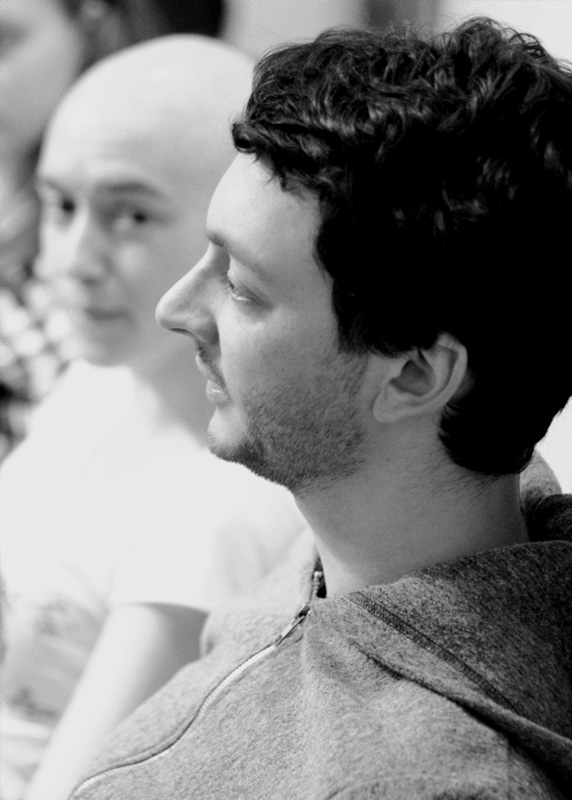
Above: Steve Ruiz by Max Herman, converted to black and white (halftone) for publication.

PG: For what did you hope when you came to Chicago? A degree? A job? What did you think that you'd find here? What was your first impression of the city?

SR: After completing my undergraduate education, I came to Chicago to be an artist. I came to join an art community which I had followed from a distance while I studied at college. I wanted, eventually, to go to graduate school. But, more than anything, I wanted to find a place where my personal talents, habits, and way of engaging the world generally, might be useful, might have an audience, and might "link up" with other people who were doing similar things.

I don’t know that I can recall ever having had a first impression of the city, inasmuch as I grew up so near to it. But, when I started to make a habit of spending time there, whatever preconceptions I had were proved untrue. There was a lot that I didn’t understand; there were a lot of people who I didn’t know; the place and its peculiar history
held a lot of meaning that I had yet to absorb.

PG: Did you attend a school here? Which school did you attend? How long were you in school here? Did you receive a degree here? When did you receive your degree?

SR: Yes, I attended the University of Chicago between September 2011 and June 2013. And I earned an MFA.

Above: Steve Ruiz at left, co-curator, with Andrew Blackley and Stephanie Burke, of Quarterly Site #4, seen here standing with a friend before work by Anna Kunz, at LVL3, 1452 N. Milwaukee, Chicago, IL, on October 9, 2010.

PG: How long were you in practice here? Did you enjoy success on your own terms? Can you recall some peak experience? If you felt frustrated, what frustrated you? Poor sales? Lack of publicity? High rent? Crime? Inefficient transportation? Public apathy? Bad weather? What was the total amount of time that you spent as a resident?

SR: I wrote and made art in Chicago between 2009 and 2015. I enjoyed success relative to the goals I set for myself: to meet artists and others interested in art; to connect with creative people; to write about art; and, to make paintings. I was able to show my art alongside some very excellent artists. And I believe that people took me seriously: in what I did, wrote, and made. My frustrations included: a sense that financial reward was very distant; a lack of routes outside of the city for art and other cultural production; and, in general, a feeling that I was in the minor leagues--that there wasn’t enough to go around. I spent about five years in the city itself.

PG: How does Chicago know you? Does Chicago know you? Have you been misunderstood?

SR: Within the art community at least, Chicagoans knows me for my writing, my art, and my management of The Visualist: the city’s visual art events and openings calendar. I co-founded The Visualist in 2011 with Jenny Kendler and Chad Kouri; I've been editing it ever since.

I was most active as a writer
(at Chicago Art Review, then later ArtSlant and Daily Serving, among others) between 2009 and 2011, during which period many people might have known me best as a writer. More recently though, I’ve done less writing and more painting. So, I feel that there might be some year-to-year difference in my reputation--depending on when people knew me.

I had some of the "many hats" misunderstanding which is common to the city’s artists; but there were only a few months when that bothered me: between the initial gladness of having a reputation at all, and the later satisfaction of having more than one thing in which to take pride. Having written that, the stakes were so low that I never felt like I missed out on anything.

Above: Steve Ruiz, foreground, and Lori Waxman, background, participating in the "Crisis-Free Arts Criticism" salon at threewalls, 119 N. Peoria, Chicago, IL, on March 1, 2011.

PG: Was there an event which precipitated your departure? For which other city did you leave? What was waiting for you in that other city?

SR: I moved to Cambridge, England, to be with my fiancé, Marie. We met while I was at University of Chicago; she was finishing her doctoral program at Cambridge, but was spending a quarter in Chicago when I met her. Many flights later, and after some period of uncertainty regarding where we would end up, she secured a job back in the city and I got my visa to join her.

PG: Does Chicago look different to you since your arrival to it and/or departure from it? Do you have advice for someone about to begin what you've finished?

SR: When I first came to Chicago, there was still a strong tradition of independent activity and scene-building. At the time I interpreted it as a moment of excitement and potential; but, in the end, it turned out to be a perennial quality of the city’s art world. In other words, the freedom and ambition that I sensed in Chicago are still there, and are still exciting--but by the time I decided to leave the city I no longer felt that it was the type of freedom and ambition that precedes change.

My advice to someone with similar interests (writing, community infrastructure, learning about place and other artists) would be to place peers above city, to focus on making meaningful connections with artists you like, to tell their stories, and to promote the work you see and enjoy, rather than to try to make something happen. I probably had it right at the start, when I was just cranking out art reviews of basement shows and artists’ first solo exhibitions.


PG: Do you expect to maintain a connection to Chicago and its art world? What's your incentive to stay connected? Have you left friends or family here?

SR: Absolutely. For the moment I’m still running The Visualist. So, I still spend several hours every week researching shows which are upcoming, submitting and editing event listings, emailing gallery directors, and clicking "Maybe" on Facebook events. I have a few shows in Chicago this Fall. And I would love to continue exhibiting my work in a city which is familiar with the place my work comes from--a city of artists who might recognize their own influences in what I do. My family still lives in Chicago, and (for now) most of my best friends do too.

Above: Steve Ruiz, at right, standing beside Sonja Alhäuser's butter buffet billy goat during the opening reception for "Feast" at the Smart Museum, University of Chicago, 5550 S. Greenwood, Chicago, IL, on February 16, 2012.

PG: By what means do you stay abreast of developments in the arts in Chicago? Print? Social media? Visits?

SR: Running The Visualist keeps me up to date, though I read reviews of exhibitions fairly regularly, and I follow the certain careers of artists I like (whether I know them well) who are still in, or exhibiting in, Chicago.

PG: In the end, is place important? Is physical location a matter of consequence in 2015?

SR: Yes. The paintings I’m making these days come directly from the experience of deep place that I had in Chicago: a city animated--brought to life--by the layers of memory, history, narrative, and myth which lie over it. For me, living in Chicago was like living in an imaginary place, fully furnished with an infinite amount of detail and meaning. As a resident of anywhere, it is impossible to keep that layer of imagination out of your head; and if you’re in the business of expressing yourself in words or art, it’s impossible to keep place out of what you produce.

Above: "Prospect" 2015, 5.5 x 7.5 inches, gouache, ink, and enamel on paper, by Steve Ruiz; converted to black and white (halftone) for publication.

PG: Was some important subject omitted from this query? Please introduce any additional material which you believe to be relevant.

SR: This interview didn’t ask who I knew, who was important to me, or who inspired me to stay as long as I did. With many omissions, and in no particular order, that list would include: Philip von Zweck, Ed Marszewski, Jamilee Polson Lacy, Marc Fischer, Magalie Guerin, Ryan Travis Christian, Marcie Oakes, Matt Irie, Scott Wolniak, Geoffrey Todd Smith, Deb Sokolow, Abraham Ritchie, Matt Irie, Deborah Boardman, Chad Kouri, Dana Bassett, Britton Bertran, and Nelson Bland.

- May 9, 2015 (C) Steve Ruiz

Learn more about Steve and his work by visiting his website: http://steveruizart.com/
Image (1) above provided by Steve Ruiz, copyright (C) Max Herman; filter applied.
Images (2-4) above copyright (C) 2010-2012 Paul Germanos.
Image (5) above provided by Steve Ruiz, copyright (C) Steve Ruiz
; filter applied.
Edited by Paul Germanos. Apologies for errors and omissions. Contact using the information at right.

June 3, 2014

2014: Autumn Elizabeth Clark @ Winkelman-Milling Projects

Above: Autumn Elizabeth Clark, candid, standing before her video installation at Winkelman-Milling Projects on May 30, 2014.
Autumn Elizabeth Clark
"I haven’t come yet"
May 30 - June 20, 2014
Winkelman-Milling Projects
960 W. Cullerton Street
Chicago, IL

http://www.autumnelizabethclark.com

http://www.winkelmanmillingprojects.com

Note: At the time of the writing of the review (below) the author found no press release from the gallery, nor published statement from the artist, with regard to the exhibition in question.  No prior contact with Autumn Elizabeth Clark or her artwork informs the following text.

Above: Street signs at the intersection, Cullerton and Sangamon, nearest to Winkelman-Milling Projects in the neighborhood of Pilsen.
8:45 PM, Friday, May 30, 2014: Free, legal, parking on Chicago's streets is increasingly difficult to find.  As a result, some patrons of the arts now avoid whole neighborhoods: ignoring the venues therein.  Subject to gentrification, Pilsen too is changing; in fact, Pilsen has already changed.  But, this evening, Winkelman-Milling Projects, at 960 W. Cullerton Street, proves accessible.

Above: The entrance of Winkelman-Milling Projects, as seen from the second floor landing on May 30, 2014.
Winkelman-Milling Projects, currently located on the second floor of a residential building, is probably best described as a species of apartment gallery.  And, Autumn Elizabeth Clark's "I haven’t come yet" is the site's inaugural show.  Clark herself is still a graduate student at the University of Chicago, anticipating the receipt of her MFA degree in 2015.[1]

Above: Tish Noel, back to camera; Autumn Elizabeth Clark, center, facing camera; Bill Gross, right.[2]
A young artist, and especially one found in a young space, practically guarantees some unresolved technical issue in presentation.  Here, the issue is illumination.[3]  The only sources of light within the exhibition space are: (a) Clark's video installation; and, (b) a series of holy candles placed, by the proprietors, around the perimeter of the gallery.

Above: A holy candle, bearing Most Sacred Heart of Jesus iconography, at Winkelman-Milling Projects on May 30, 2014.
Whether Winkelman-Milling's west-facing windows might have allowed the setting sun to supplement the scene is a moot point past 8:30 PM.  And it takes some time for visitors to identify the artist's fiber works and photography, four pieces of which are mounted on the gallery walls.  Having done so, a striking contrast to the aforementioned candles is revealed in the form of a goat-headed entity embroidered upon what is said to be a mask.

Above: "I haven't come yet (I)," 2014, 21 x 23 inches, embroidery, by Autumn Elizabeth Clark.
Located on the east side of room's south wall, the object depicted above is seen to reappear, worn by a male figure, in a photograph placed (nearby) on the west side of that same south wall.  Other fiber work, more obviously intended to be worn as a sort concealment, is found on the opposite side of the same room.

Above: "Untitled," 2014, 19 x 24 inches, embroidery, by Autumn Elizabeth Clark.
Conceptually, Clark seems focused upon a series of oppositional relationships or, maybe, binary systems, e.g., bare-concealed, male-female, public-private, master-slave.  And that suggestion is reinforced by the split-screen form, as well as the content, of her centerpiece video work.

Above: "Homevideos," 2014, dimensions variable, digital video, by Autumn Elizabeth Clark.
In sum, the venue, artist, artwork, and audience give some hint of where Chicago's "counterculture" is and has been, philosophically, for the past fifty years--so that it's tempting to wonder about the Marxist and Feminist tropes which have (predominantly if not exclusively) shaped such intellectual dialogue as exists within the city's "arts community."

It can be a very difficult time and place in which to ask questions.  For example: If we consider that gender roles might be socially constructed, and "not natural," should we also consider that the movement to deconstruct gender roles might originate in an equally human, and consequently "unnatural," social phenomenon?

Shown above, Clark's "Homevideos," 2014, featuring both a male figure to who makeup is applied, and also Clark herself, wholly unadorned and voluptuous, suggests the great confusion of our time.[4]  And it would be interesting to hear, from the artist, why such a work would not have fit in "State of Mind: New California Art Circa 1970" which was hosted by the University of Chicago's Smart Museum of Art from October 3, 2013 to January 12, 2014.

Above: University of Chicago BFA candidate Nicole Cherry, right, at Winkelman-Milling Projects on May 30, 2014.
It's tempting to interpret the show as a very personal effort to reconcile the contradictory demands being made upon artists emergent in an era defined by the collapse of the institutions against which their teachers were taught to rebel.  Whether such reconciliation is possible remains to be seen.

Notes:

[1] Autumn Elizabeth Clark is the graduate assistant for Laura Letinsky.

[2] Autumn Elizabeth Clark was an intern at Bill Gross' 65GRAND gallery 2012-2013.

[3] The scene of the exhibition was so dark that the presentation of photographs which were "true" would also have meant the presentation of useless, nearly black frames.

[4] The artist and hosts were courteous. And it's a reminder that such little civilization as we are left to enjoy depends more on our mutual behavior than it does on our intellectual consensus.

Above:
Images (1, 5, 6, 7, 8) May 30, 2014, shoe-mounted, on-camera flash used;
Images (2, 3, 4, 9) May 30, 2014, available light, large aperture, slow shutter, and high ISO, only;
Copyright Paul E. Germanos.

February 3, 2014

2014: Judy Ledgerwood @ Smart Museum

Above: Artist talk with Judy Ledgerwood and Christine Mehring, Smart Museum of Art, 2:00 PM, February 2, 2014.
Judy Ledgerwood
"Chromatic Patterns for the Smart Museum"
December 26, 2013 - Spring 2015
Curated by Jessica Moss, Associate Curator for Contemporary Art
The David and Alfred Smart Museum of Art
University of Chicago
5550 S. Greenwood Avenue
Chicago, IL 60637

http://smartmuseum.uchicago.edu/

http://www.rhoffmangallery.com/ 

"Chicago-based artist Judy Ledgerwood’s immense, site-specific wall painting for the Smart Museum is part of an ongoing series inspired by the energetic, asymmetrical rhythms of composer Morton Feldman’s 'Patterns in a Chromatic Field' (1981).  The painting is comprised of horizontal bands of boldly colored patterns—blue with bronze, fluorescent red with mint green, spring green with copper—that run across the large central wall in the Smart’s lobby. The work responds to both the soaring, symmetrical architecture of the space and, in its repeating patterns, the design of Louis Sullivan’s elevator screens for the Chicago Stock Exchange building (two of which are on view in the lobby).  The artist (with the help of an assistant) painted Chromatic Patterns by hand directly on the wall. The work, in the artist’s words, is made to 'hang tapestry-like' with drooping and irregular edges that contrast with the clean lines of the Museum’s modernist architecture."

"Chromatic Patterns is generously supported by the Efroymson Family Fund, the Pritzker Traubert Family Foundation, and Jack and Sandra P. Guthman."

Quotation above from: http://smartmuseum.uchicago.edu/exhibitions/judy-ledgerwood-chromatic-patterns/

A related exhibition runs concurrently at the Graham Foundation:

Judy Ledgerwood
"Chromatic Patterns for the Graham Foundation"
January 23 - April 5, 2014
The Graham Foundation
Madlener House
4 W. Burton Place
Chicago, IL

http://www.grahamfoundation.org/

Above: Artist Judy Ledgerwood with art historian Christine Mehring, 2:00 PM, February 2, 2014.
Above: Artist talk with Judy Ledgerwood, left, and Christine Mehring, right, 2:00 PM, February 2, 2014.
Above: Artist talk with Judy Ledgerwood and Christine Mehring, 2:00 PM, February 2, 2014.
Above: Artist Judy Ledgerwood, foreground,  "Chromatic Patterns for the Smart Museum," background.
Above: Smart Museum exterior; "State of Mind: New California Art Circa 1970," October 3, 2013 – January 12, 2014.
Above: "Chromatic Patterns for the Smart Museum," on January 12, 2014.
Above:
Images (1-7) February 2, 2014;
Images (8-9) January 12, 2014;
Copyright Paul E. Germanos.